What’s Your Side Project in Redemption?
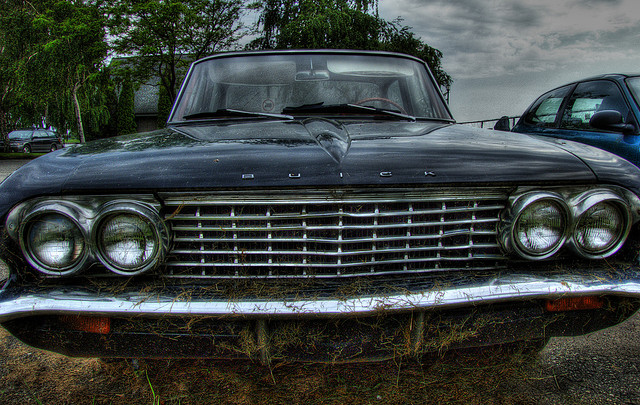
My dad has a friend named Irv. Irv’s lifelong passion is working on cars, and I’m not talking about classic roadsters or sexy sports cars. The beater everyone else has given up on is more Irv’s speed. He relishes showing the world he can get another 30,000 miles out of that old Buick. I don’t know what Irv’s day job is, but he lives to slip on his jumpsuit, step into his garage, and get his hands in the grease and metal. Irv reminds me of this theory I have. It’s nothing scientific, just a pet hypothesis I’ve been nursing for a while. It goes like this: the thing that makes life worth living is a side project in redemption. A little piece of art on the side that you’re loving on. A beat-up car you’re restoring. A manuscript you’re tinkering with. A scrapbook you’re creating. A child (or adult) you’re helping. A triathlon you’re training for. A dish you’re perfecting. Whatever that is for you, keep doing it. Better yet, do more of it. Stop watching so much TV and attend to your art instead. That’s what we need from you. That’s where your desire and the world’s need come together. At this point I’m supposed to say that if you work really hard on it, this side project will become your day job. And of course this does happen. Jon Acuff wrote a great book on the possibility. But what if that doesn’t happen? What if this is always just a side project for you? So what? You see, I think sometimes we hijack what’s possible now because it can’t live up to our hopes for it. We crush the now because we’re afraid of then. But that’s crazy. Better to let go of those expectations and just do your thing—today. Don’t worry about tomorrow. A wise man said, “Tomorrow has enough trouble of its own.” But today. Today you can make a choice to engage your passion. Today you can tell the other voices to go to hell. Today you can be the artist you were made to be. What’s your side project in redemption? P.S. This blog is mine.
Why Getting Naked Is the Best Thing You Can Do for Your Writing
The best writing is naked writing—vulnerable writing, writing that draws from your own experience, directly or indirectly. Any other kind of writing is phony, and readers can smell it a mile away. Would you trust a yoga instructor who told you what to do without doing it herself? Would you trust a carpenter who never picked up a hammer? Then why do writers sit up there in an ivory tower tossing pages out of the window, expecting us to run after them? Readers won’t care what you have to say until you come down here and be yourself. Manufactured writing is boring. Hackneyed. How do you get naked? 1. Write what you know. You know plenty, but it takes discipline to be introspective enough, self-aware enough to know what you know. Seek for this, then tell us all about it. 2. Go after more experiences. Let’s say you want to write something, but if you’re honest you don’t know much about it. Interview the experts. Get some related experiences on the calendar. 3. Commit to the process of revealing yourself. W. H. Auden, wrote, “How do I know what I think until I see what I say?” Henri Nouwen spurned writing that merely recorded preexisting thought. “Writing is a process in which we discover what lives in us. The writing itself reveals what is alive.” 4. Go deeper. The deeper stuff is the universal stuff. “If I can tell my story artfully enough,” Robert Benson wrote, “then perhaps those who read them will, at the end of the telling, be able to hear more of their own stories within.” 5. Go from the abstract to the concrete. The best communicators speak on the level of the concrete as much as possible. Don’t write “about” things. Get into them and make them come alive. 6. Be honest. Everywhere and always, even if it’s more expedient to cover up. 7. Have a partner or a friend who knows you read what you’ve written. Then ask, “Does this ring true?” The last way to get naked is the most important, and I promise whatever effort you invest here will be worth it. The last way to get naked is to commit to becoming a person you’re pleased with. If you don’t like yourself, the temptation to avoid yourself will be too great. The writer you is an extension of the real you; the two are not separate. If you don’t like yourself right now, what would it take to begin moving in that direction? The time is now. What are you doing to get naked in your writing?
5 Ways to Do What Matters Most to You
Steven Pressfield, author of the powerful kick-in-your-pants The War of Art, believes in two powerful voices in the world: A negative, dark voice that will stop at nothing to keep you from doing the things you believe are most worth doing. Pressfield calls this the Resistance. This voice is absolutely real. It is deadly. And it means business. An equally powerful positive voice. The ancients called it the Muse. Others might call it the Spirit or the Divine Light or Inspiration. (Interesting: the verb “to inspire” can be literally translated “breathe into.” When we are inspired, we are breathed into.) This voice is also absolutely real, and it is on your side. If we want to accomplish the best of what we have for ourselves and others, the trick is to listen to the right voice and stop listening to the other. But how? Five ideas: Be intentional about your stimuli. As you look at what you want to accomplish in the next three months or three years, what books, blogs, podcasts, and videos would help you get there? How can you use technology to make engaging these stimuli easier? When will you take in these stimuli? Should you schedule doing so? Notice what inspires you. If being inspired means being breathed into, and if inspiration is the stuff of this real, positive force that can take us where we want to go, then it behooves us to notice what inspires us. What’s inspiring you these days? Notice this, talk with your friends about it, take notes. Anne Lamott in Bird by Bird encourages writers to imagine all the voices of criticism—you could think of these as the voices of Resistance—in a jar with a volume knob attached to it. These voices include your internal, never-stops-chattering editor; your overbearing mother; your inner (needy) child. You get the idea. Place all these voices in a jar and then turn the volume up. Turn it up and keep it there. Hear them? They’re shouting. They’re angry. They don’t much like you. Now, quickly, turn the volume knob down until you can’t hear them at all. Now place the imaginary jar out of sight. Peter Bregman, author of a terrific time-management book 18 Minutes, says, “Don’t give up in the moments when you’re most vulnerable.” For me, it’s at night. I get sucked in by those naughty late-night sirens David Letterman, Jay Leno, Jimmy Kimmel, and then I’m too tired to wake up early the next morning, which is when I exercise and write. So here’s the deal I’ve made with myself. I don’t have to work hard all the time. Just at night—actually, for one half hour, from 9:30pm to 10:00pm. Every day I live 48 half-hours, and for 47 of them I can take it easy, more or less. But for this one half hour, I need to put on the helmet, grab the machine gun, and push through. If I do, I’m well on my way to doing the things that are most important to me. This one is perhaps the most important. Find or create a group that will support you. Every month I gather with a group of five to seven other creatives. We time ourselves, go around the circle, and ask three questions: What’s inspiring you? What are you working on? What would you like prompting on? We got the idea from Todd Henry’s book, The Accidental Creative, which has been a true game changer for me. Don’t focus so much on not hearing the negative voice. Try instead to think of ways to nurture the good voice. Make it your goal to be so busy listening to the right voice that you just don’t have time to hear the other. How about it? How do you practice listening to the right voice? I would love to hear your thoughts.
The #1 Reason We Turn Books Down . . . And How It Can Help You Get Published

Several weeks back I attended the International Christian Retail Show, which is the main annual event for Christian booksellers and related vendors. I’ve attended this show the past several years because it’s a good place to meet with industry friends, authors, and literary agents. One afternoon my editorial colleagues and I sat around a table with a group of literary agents, discussing some projects we editors had decided to pass on. As we talked I found myself making a rather definitive statement: “The number 1 reason we turn books down is lack of platform.” If you’ve come within a hundred feet of trying to get published by a traditional publisher, you’ve likely encountered this publishing peeve more times than you care to think about. Platform. What is it? How do you build one? And are there ways to avoid the need for one? Michael Hyatt, who recently wrote a book titled Platform: Get Noticed in a Noisy World, a book I highly recommend, defines it this way: a platform is “something that enables you to get seen and heard.” Another way to think about it is this: a platform is any means of bringing exposure to your book. At this point some will get bent out of shape. “Wait one minute,” a person might say, “Isn’t getting exposure for a book what publishers do?” And of course it is. Among a number of services we provide, such as editing and design, our marketing, publicity/social media, and sales staff work hard to reach as wide a readership as possible for each and every book we publish. The reality, however, is that the effectiveness of our efforts multiplies exponentially when we combine our resources with those of a well platformed author. Publishing is nothing, and never has been, if not a partnership. Is there any way to sidestep the need for a platform? To be honest, usually, no, there’s no way to get around it if you want to work with a traditional publisher. But I do know of three ways whereby a platform is, relatively speaking, less necessary. Write a compelling novel. I personally do not work in fiction, so I can’t speak much to this, but I’m aware that saleable novels often do not require a platform, though they certainly would be helped by one. Write an engaging story or memoir with truly outstanding prose. Honestly, unless you’ve been writing diligently for over ten years, it’s doubtful you can pull this off. But every now and again, an exceptionally well written memoir by an unknown author can get a publisher’s attention and do really well in the marketplace. Girl Meets God and Blue Like Jazz come to mind. Come up with a great concept usually represented in the proposed title and pair it with great writing. The example I point to most often here, because I acquired it, is a book by Vince Antonucci called I Became a Christian and All I Got Was This Lousy T-Shirt. Vince did not have much of a platform, but we liked this title and we liked his writing, so we said yes to this one. Other examples from Baker Publishing Group include: 50 People Every Christian Should Know by Warren Wiersbe Living Successfully with Screwed-Up People by Elizabeth B. Brown How to Talk So People Will Listen by Stephen W. Brown Everything the Bible Says about Heaven Laugh-Out-Loud Jokes for Kids by Rob Elliott I hasten to add that many of the authors above do have platforms. But these concepts have turned out to be so saleable, a platform in these cases seems (again, relatively speaking) less important. Lest you get too excited too quickly, let me issue a caution. These concepts are hard to come by, and even if you did land one, it’s doubtful you’d be able to come up with another. In other words, it is difficult to sustain a writing career with this sort of book, and even with a highly saleable concept, having a platform will only help you in the long run. So, how do you build a platform? The old way of doing it, I suppose, was to build a following gradually any way one could—speaking engagements, articles, mailed newsletters, products, books, and so on. And some of this is still very much worth doing. We can tell when our authors are on the road speaking because we see a corresponding bump in sales of their books. The current way to build a platform, though, is all about using the internet and social media. I don’t have the space to go into detail about this, but if you read Hyatt’s book and Tribes by Seth Godin, you’ll easily have the equivalent of bachelor’s degree in building a platform. The reality is it has never been cheaper or simpler or faster to build a platform than it is today. But it does take determination and a lot of hard work. What are you doing to build your platform?
Over at Rachelle’s place today…
Pleased as all get out to be a guest blogger at Rachelle Gardner’s blog today. The post: 13 Ways to Write with Urgency. Hope to see you over there!
Why the Destination Isn’t Everything . . . Not Even Close
In 1977 NASA launched two spacecraft, Voyager 1 and Voyager 2. Their primary mission was to collect data in interstellar space, but they had enough power to continue on to the end of our solar system. Now, 35 years later, they appear to be getting very close. When they escape, it will be the first time in history a man-made object has left our solar system. It will, in fact, be the first time a man-made object has left any star. I have an agreement with a friend that we’ll call each other and celebrate over the phone when it happens. I might even throw a party. I learned about all this, incidentally, via a RadioLab podcast. Todd Henry recommend RadioLab to me a while back, and I just love their work. Highly recommended. But what about those 35 years? Has Voyager’s journey up until this highly anticipated moment been a waste? Far from it. In the seventies and eighties the Voyager spacecraft sent back the first close-up pictures we had ever seen of the planets. For the first time we saw Saturn’s rings up close. We saw that Neptune is the most beautiful shade of blue. But it gets better. In 1990 NASA was about to power down the spacecrafts’ photographic function to conserve energy, but scientist Carl Sagan encouraged them to take one last picture. He asked NASA to turn one of the Voyagers back to Earth and take one last picture. The result is the famous “Pale Blue Dot” photo, which I’ll include here. Earth is that small bit of blue about halfway down on the right. Carl Sagan pointed and said, “Look again at that dot. That’s here. That’s home. That’s us. On it everyone you love, everyone you know, everyone you ever heard of, every human being who ever was, lived out their lives. . . . Every saint and sinner in the history of our species lived there–on a mote of dust suspended in a sunbeam. . . . Think of the rivers of blood spilled by all those generals and emperors so that, in glory and triumph, they could become the momentary masters of a fraction of a dot.” This picture was never part of Voyager’s mission. It happened because a scientist had the foresight, the curiosity, and the verve to ask NASA to take it. Sagan was open to the journey. You probably have a destination in mind. You want to write a book or an article. You want to publish your thoughts for all the world to read. But don’t forget about the journey. Enjoy it. You never know what you might discover along the way. What are some discoveries you’ve made along the way?
How to Write Stuff Everyone Wants to Read
I’ve been helping authors write for nearly fifteen years, and I have found one idea in particular has helped them to take their writing to the next level. It’s not original to me; it comes from Sol Stein and his book Stein on Writing, which I highly recommend to anyone who wants to write well. Here’s the idea: the purpose of writing is “to provide the reader with an experience that is superior to the experiences the reader encounters in everyday life.” Writers write for all kinds of reasons: to make money, to express themselves, to get famous, to communicate, to make an argument, to add to a conversation. All of these reasons are fine if kept in the right place. But the first reason is to create an experience that readers bolt to over other experiences. Writers sometimes make the mistake of believing they are competing against other writings for readers’ attention. If I’m a novelist, my competition is other novels. If I write essays, I think my competition is other works of nonfiction. But actually, the writer’s competition is anything else that could capture a reader’s attention. This sounds daunting, I know. How on earth are we as writers supposed to communicate with TV, iTunes, in-person conversations, online surfing, going to the beach, and other countless diversions? It’s not easy, but until we realize what the goal is, we don’t stand a chance. So how do we create experiences that are better than others? Here are five tools that can help you get started. Recognize that reading is an experience. Whether I’m clicking a link, firing up my Kindle, or opening a book, as soon as I start reading, an experience has begun. Your goal as the writer is to make this an experience no one wants to leave. “The best reading experiences defy interruption,” says Sol Stein. Recognize your role. As a writer, you are an experience architect. It’s important, therefore, to ask, how can I create the best experience possible with this first line, this paragraph, this chapter? What question can I answer? What need can I meet? Write visually. Write in a way that engages the imagination. If readers can see what you’re saying, they will stay with you. Key question: Is it filmable? Write, get feedback, and write some more. You’ve heard how important it is to keep your butt in the chair and produce pages (Stephen King thinks we all need “butt glue.”) The other important part of this is getting feedback from people whose opinions you value. Start a writer’s group or join one. Read. Read New York Times bestsellers in your genre. And every once in a while read a book on writing. My favorites, in addition to Stein on Writing, are Anne Lamott’s Bird by Bird, William Zinsser’s On Writing Well, Stephen King’s On Writing, Annie Dillard’s The Writing Life, and Natalie Goldberg’s Writing Down the Bones. Question: How in your own writing do you create experiences that are superior to those of everyday life?