What to Do When Your Book Stops Selling

Ever had a book that earned glowing reviews but mysteriously stopped selling? Recently an author friend emailed me with exactly this problem. Her book was praised as “life-changing” and “literary excellence,” yet sales slowed down drastically. Sound familiar? You’re not alone. Let’s dive into why this happens—and how to revive book sales. Why Do Great Books Stop Selling? Writing a book is a monumental effort. So it’s incredibly frustrating when sales suddenly dry up. Often, authors are left wondering what happened and how to reignite interest. Two Common Reasons Your Book Isn’t Selling (and How to Solve Them) The concept isn’t tied clearly to a felt need.Readers buy books to solve problems. Even fiction solves the “problem” of boredom or the desire for escape and entertainment. If your book isn’t explicitly addressing a real, felt need, readers won’t clearly understand why they should invest in it—even if the content is fantastic. Marketing stopped too soon.Authors typically invest a lot in early promotions, then move on to other things. But often books that continue to sell are those with ongoing promotional efforts. Your book can reach new audiences continuously—but only if you keep putting it out there. How to Revive Book Sales My author friend, after hearing these tips, began developing fresh marketing ideas. She’s now considering a 15th-anniversary edition with bonus content, serializing excerpts on Substack, and leveraging niche communities online. She’s excited again—and her book has new possibilities. Here’s how you can revive your book’s potential: Clarify your book’s core benefit. What real need or desire does it fulfill? Implement ongoing marketing strategies, like special editions, partnerships, or guesting on podcasts. Engage your audience regularly, highlighting how your book uniquely solves their problems. Looking for more marketing ideas? Check out my favorite book on book marketing, Tim Grahl’s Your First 1,000 Copies. What’s Next? Ready to give your book a second life? Pick one idea from this post and try it this week. I’d love to hear how it goes! What’s one step you’ll take today to boost your book’s sales?
How to Write a Useful Book That Markets Itself
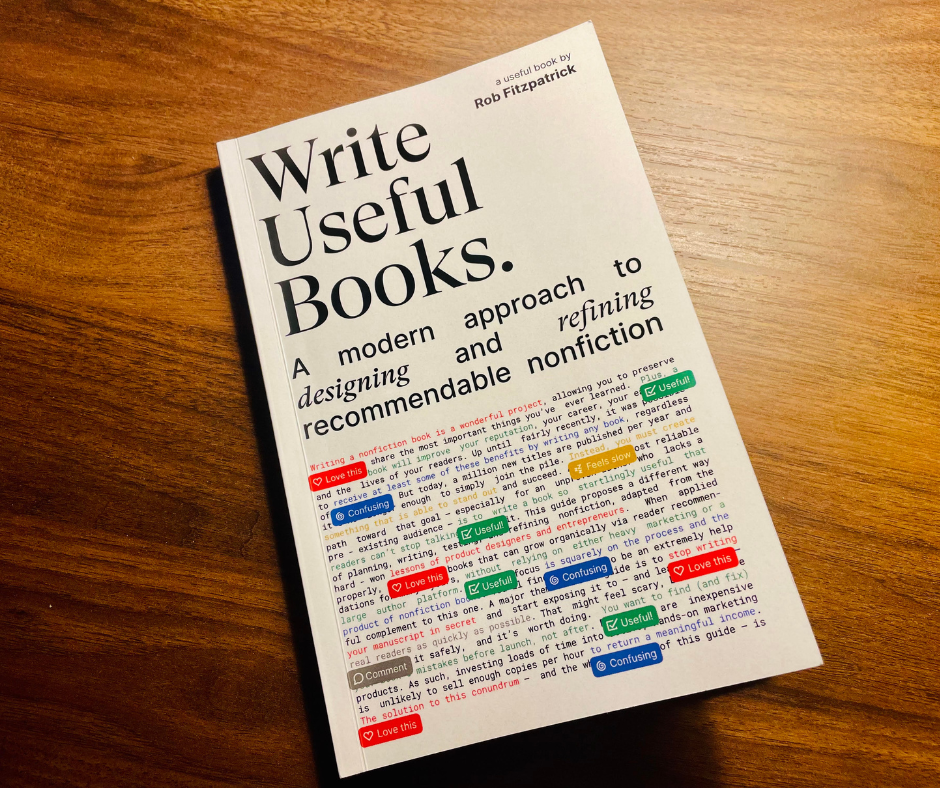
Do you know what’s even better than a great book? A great book that recommends another great book! That’s exactly how I came across Write Useful Books: A Modern Approach to Designing and Refining Recommendable Nonfiction by Rob Fitzpatrick. AJ Harper recommends it in her masterful Write a Must-Read. As soon as I finished Harper’s book, I picked up Fitzpatrick’s and promptly devoured it. It is mainly for nonfiction writers, though some of the content about publishing and optimizing for sales may be helpful to fiction writers. At 135 pages, Write Useful Books can easily be read in a few sittings, but don’t let that fool you. This book is packed with value. In this blog post I’ll share a summary of the book, what makes it unique, and my take on which writers will find it most, well, useful. Marketing Optional Fitzpatrick’s goal is to help you write a book that is so useful, it markets itself. “For properly designed nonfiction,” he writes, “ongoing marketing becomes an option rather than an obligation.” How’s that for a promise!? And he has the experience to back it up. Fitzpatrick shares sales data from his own three books, and all three have a history of picking up steam on the strength of word of mouth. That’s how “marketing becomes optional,” by the way—by writing a book with “long-lasting recommendability.” Fitzpatrick aims to show you how. Readers, Your Allies The main thing that sets Fitzpatrick’s book apart from other books for writers is his guidance on when and how writers should solicit feedback from readers. He opens chapter 3 by asking you to imagine a builder who’s designing a house for a family, but before consulting with the family the builder just dives in and starts building. “As absurd as it sounds,” he writes, “that’s exactly what most authors do with books. They write in secret, piling up a manuscript’s worth of beautiful words and only then start figuring out whether people want it….” Write Useful Books teaches you how to get feedback from readers as you develop your book’s concept and structure, and throughout the writing process. Ultimately Fitzpatrick helps you implement an iterative process of obtaining and incorporating feedback from readers, which is what produces a book that solves a real problem your readers have. If your book helps readers solve a problem they have, they’re very likely to recommend it to others. Marketing and Money The last two chapters are on how to find your first 1,000 readers and optimize for sales and growth. He covers four paths to marketing your book without favoritism for one path over another. Rather, he tells readers to pick the path that’s easiest for them. And in the last chapter he shares ways of increasing sales and generating more revenue from your book. [Tweet “How to write a useful book that markets itself: a review of @robfitz’s book by @chadrallen #writingcommunity”] Conclusion I strongly recommend Write Useful Books to anyone writing self-help, business, or another type of prescriptive non-fiction. And in so doing I’m providing evidence that Rob Fitzpatrick has written a truly useful book! What’s the problem your book solves?
How to Pick the Right Publisher or Literary Agent for Your Book

I often get this question: “How do I find the right publisher for my book?” Standard Answer The standard answer is to go to Writer’s Market, an 896-page tome that gets updated each year. The problem is, this doesn’t really work for obvious reasons. Better Answer The better answer is what I call The Bookshelf Method, an easier and more effective process for compiling a list of agents and publishers that are perfect for your book. You can do it in six simple (and enjoyable) steps: Step 1: Grab some books off your shelf that are similar to the one you’re writing. The more recently published, the better. Step 2: For each book, note the publisher. Step 3: Flip to the copyright page and acknowledgments to determine who the agent is and note the agency. (Sometimes authors acknowledge people without saying who they are. A quick google search will reveal whether the person they’re thanking is a literary agent.) Step 4: Shoot for a list of your top five agents and publishers as well as at least five additional agents and publishers. Step 5: Don’t own enough books that are similar to yours? Time for a trip to your bookstore or library! Step 6: Research the submission guidelines of each publisher and agent. Once you’ve got your list and a great book proposal, pitch away! Photo by Cytonn Photography on Unsplash Another Benefit This method works not only for picking possible agents and publishers. It also works for compiling a list of comparable books to include in the competitive analysis of your book proposal. Want to do this? If so, jot down a few additional details for each similar book: the year of publication format (hardcover or paperback) page count price Publishers can look up this information, of course, but they really appreciate it when writers go the extra mile. [Tweet “How to pick the right publisher or literary agent for your book #amwriting #writingcommunity”] Get the Template That Makes All of This Easy To make all of this easier for you, I’ve created a simple template you can use. The template includes prompts and spaces to write down all the relevant information. You can fill it in right on your laptop or print it off and use paper and pen. Click here to download your free copy. What is one book that is similar to yours?
Best Books for Writers on Craft, Creativity, Marketing, and More!

Reading the right books can help you become a better, more successful writer, but where to start!? I’ve been an avid reader of books for writers a long time now, and it’s a topic I’ve written about in the past. But as I keep reading more books in this genre, I expand and refine my list of recommended books. In this blog post I’m going to spotlight my favorite books for writers in the following categories: Inspirational Books for Writers The Craft of Writing The Writing Life Creativity Book Marketing Here we go! Inspirational Books for Writers The winner in this category is easy: Steven Pressfield’s The War of Art: Break Through the Blocks and Win Your Inner Creative Battles. It’s short. It packs a punch. And I can pretty much guarantee you won’t walk away from this book without being changed for the better. I’ll mention two more inspirational books for writers. The first is Seth Godin’s book The Practice: Shipping Creative Work. Sometimes focus so much on outcomes, we need someone to stress the importance of staying on the journey. This book is that someone. And finally, several years ago I wrote a short book called Do Your Art: A Manifesto on Rejecting Apathy to Bring Your Best to the World. Creativity expert Todd Henry said this about it: “Chad’s manifesto delivers a simple but profound truth: you have unique art to offer the world, and deliberate action is the only path to making it happen. A wonderful (and welcome) kick in the pants!” The Craft of Writing In my opinion, the best book to help you improve your writing skills is William Zinsser’s On Writing Well: The Classic Guide to Writing Nonfiction. It is standard issue in newsrooms throughout the country for a reason. It’s that good, and it’s also quite entertaining, which of course is part of why it’s so good. Fiction writers have much to gain from Zinsser despite what the subtitle suggests, but for a book more directly focused on fiction, see Sol Stein’s Stein on Writing: A Master Editor Shares His Craft, Techniques, and Strategies. One of the things I love most about this book is how many examples Stein includes. A book that more recently hit my radar is Writing Tools: 55 Essential Strategies for Every Writer by Roy Peter Clark. I’m about halfway through it, and I can tell you it’s very, very good. The chapters are short, which makes it easy to use as a daily reader if you’d like. Each chapter is about a very practical and well-illustrated tactic. Another book that will help you improve your writing is Write Better: A Lifelong Editor on Craft, Art, and Spirituality by Andrew T. LePeau. I liked it so much, I used it for a multisession master class in BookCamp. Uniquely, LePeau writes this book from a Christian worldview, which does not mean the book is only for Christians. But this approach frees the author up to include a helpful section on the spirituality of writing. And finally, I can’t sign off on a collection of books about the craft of writing without mentioning The Elements of Style by William Strunk Jr. and E. B. White. Another classic, this slim volume is a fast read, full of wisdom. The Writing Life Admittedly, the lines get blurry between books on craft and books on the writing life. You’ll find plenty of practical writing tips in the books I’m sharing today. But the emphasis in these books is on what it’s like to be and how to thrive as a writer. It’s really difficult for me to pick a single favorite in this category, so I’ll pick two: Anne Lamott’s Bird by Bird: Some Instructions on Writing and Life and Stephen King’s On Writing: A Memoir of the Craft. Lamott is laugh-out-loud funny, and she does such a great job of normalizing all the usual fears writers face. Stephen King’s book is riveting. as you’d expect. There’s one particular scene in which King describes the moment his fortune as a writer changes, and it’s spellbinding. You’ll love it. Two other books deserve to be mentioned here. One is Natalie Goldberg’s Writing Down the Bones: Freeing the Writer Within, which presents a Zen approach to writing. I find her breezy, vulnerable writing so compelling. And then there’s Jeff Goins’ Real Artists Don’t Starve: Timeless Strategies for Thriving in the New Creative Age, the most recently published of this collection. Jeff’s a friend, and he told me the book was really just an excuse to share a bunch of stories he likes to tell. Well, the stories are wonderful, but it all holds together really well too. Creativity Books about creativity—how to live creatively, how to maximize one’s creative output, etc.—are among my favorite books to read. Todd Henry’s The Accidental Creative: How to Be Brilliant at a Moment’s Notice changed my life. Reading this book was the first time I encountered the idea that I could live in a way that facilitated my best, most creative work. Todd, who since has become a friend, not only explicates this idea; he provides a method for living it out. Elizabeth Gilbert’s Big Magic: Creative Living Beyond Fear is a wonderfully rich read, and perhaps more narrowly focused on the work of writers. Gilbert’s a master storyteller. You find yourself swept up in her narratives as you glean lessons that powerfully enrich your creative life. I love Austin Kleon’s three little books, Steal Like an Artist, Show Your Work! and Keep Going. They’re in a smaller format than typical trade books, very fast reads, and full of all kinds of engaging art. Fun! Have you heard about Brian Grazer’s A Curious Mind: The Secret to a Bigger Life? Grazer is Ron Howard’s business partner and has helped produce such films as Splash, 24, A Beautiful Mind, and Apollo 13. One reason this book is so great is because you get to live vicariously as Grazer interacts with such people as Mick Jagger, Princess Diana, and Isaac Asimov. But I love the practical suggestions in this book too, including what he calls “curiosity conversations.” Finally, a children’s book deserves mention here. Kobi Yomada’s What Do You Do with
How Big a Platform Do I Need to Land a Book Deal?

Blog reader Ryan Atkins from Flat on My Back recently emailed this question about platform: “In a recent post of yours, you mentioned having at least 1,000 email subscribers before moving forward with publishing. This was surprising to me as I had assumed differently after hearing much higher numbers from query rejections last year. After hearing 10,000+, I started to pursue self-publishing.” Many writers understand book publishers want to work with writers who have a platform. A key metric for determining platform size is number of email subscribers. So how many do you need? If you asked fifty different publishing professionals how large an email list you need to secure a book contract, my guess is you’d receive quite a variety of answers, such as: “At least 1,000” “No fewer than 10,000” “100,000 or more” “We don’t make decisions based on number of email subscribers, so it’s a moot point.” In other words, you’d get a grab bag of different responses. The Exception That Proves the Rule Part of why a universal list size does not exist is because other key factors influence a typical publishing decision. Two of these are: how compelling the book’s concept is how good the writing is Sometimes a writer with a very small platform can land a book deal on the basis of these other factors. That happens, but in my experience (20+ years in the nonfiction trade publishing industry), such book deals are the exception that proves the rule. The rule is that anytime you submit a book proposal to agents and publishers, you are in competition with writers who have considerable platforms. Put yourself in a publisher’s shoes. If all else was equal, would you rather publish Author A who has the ability to promote her book in a significant way or Author B who lacks that ability? If I’m Going to Do the Marketing, Do I Need a Publisher? Publishers want to partner with authors who can help them promote, but that doesn’t mean publishers don’t do any marketing. Any traditional publisher worth its salt will have a budget for marketing the books it publishes. Examples of promotional activities publishers regularly do: listing your book in their catalog, which is distributed to accounts advertising lining up interviews for the author on podcasts, TV, and radio placing excerpts of the book in targeted publications All of these activities can have a real impact on the reach of your book. The other thing a publisher does is sell your book to a wider network of outlets and accounts than you would be able to reach on your own. Amazon is obviously the big player in retail, but publishers have relationships with other accounts that sell books. Think spinner racks in airports, independent bookstores, and nonprofit organizations that buy books to give away to donors, to name just a few. The most important marketing function a publisher can perform is likely collaborating with authors to think strategically and develop a winning marketing plan. Why 1,000? So why do I say a 1,000 instead of 10,000 or 132 or 100,000? To be honest, I’d rather not give a number at all. When you ask “How big does my list need to be?” I’d like to say “How big an impact do you want to have?” and leave it at that. But writers are persistent! They want a number. And I get it, it’s helpful to have a measurable goal to shoot for. I say to shoot for 1,000 because you can’t get to this many subscribers without some serious effort, not if you grow your list the right way (which is to say buying a list doesn’t count!). And I’m confident anyone who has grown a list the right way to 1,000 subscribers would back me up on this point. [Tweet “How big a #platform do I need to land a book deal? #amwriting #askeditor #bookdeal #writetip @chadrallen”] What Writers Really Want The reality is writers can get so fixated on hitting a number that they forget the point of it all. The purpose of growing a platform (read: growing an email list) should not be to hit a number or land a book deal. The purpose of a platform is to serve an audience, to effect a change in people’s lives, a change they want and are willing to pay for. In this way building a platform and getting your book published are best seen not as two distinctive objectives but as part of the same whole. This whole project—writing your book, getting published, building your platform, blogging or podcasting or speaking, promoting your book—all of it is about one thing: serving your audience. Sometimes list building feels (and in fact, is) very different from, say, writing a chapter of your manuscript. But don’t miss the connection. In both you are helping your reader get closer to the person she wants to become. And of course, in so doing you are becoming the person you want to become. How do you serve your readers?
How Writers Can Use Speaking to Build a Platform and Sell Books
Grant Baldwin is the founder of The Speaker Lab, a training company that helps public speakers learn how to find and book speaking gigs. Through his popular podcast The Speaker Lab and flagship coaching program Booked and Paid to Speak, he has coached and worked with thousands of speakers. His book, The Successful Speaker: Five Steps for Five Steps for Booking Gigs, Getting Paid, and Building Your Platform just released, and it’s a gold mine if you want to use speaking gigs to build your platform and sell books. In this interview we cover: How Grant went from being a youth pastor to a successful public speaker to a trainer and coach for other professional speakers The biggest mistake aspiring speakers make How successful speakers rapidly grow their businesses and platforms How to book more speaking gigs How writers can use speaking to land book deals and sell more books How speaking can help you improve your writing The biggest differences between speaking and writing What you’ll find in Grant’s book, The Successful Speaker, that you won’t find anywhere else And much more! Enjoy! To order your copy of The Successful Speaker, click here. To connect with Grant and hear about his programs for speakers, click here. [Tweet “Have you ever thought about becoming a professional speaker? Check out this info-packed interview with @GrantBaldwin @chadrallen #amwriting #speaker #thespeakerlab”] What was the most helpful thing you heard in this interview?
How a Writer Faced His Fear and Landed a Book Deal
Writing a book proposal and landing a book deal is hard work, but it can be done. I recently sat down for a video call with writer, spiritual director, and speaker Brian Plachta about his journey from a small platform to a landing a book deal. We talked about: how Brian pushed through his fear why he decided to write a book proposal and pursue a traditional book deal 3 strategies he used to grow his platform how friends have helped him on the journey his top 4 pieces of advice for anyone who wants to get published and much more! Enjoy! To connect with Brian, visit www.BrianPlachta.net. Resources mentioned in this interview: To learn more about how I help writers get their books into the world, visit www.chadrallen.com/products. [Tweet “How a Writer Faced His Fear and Landed a Book Deal #amwriting #WritingCommunity #askeditor #writetip @chadrallen”] What did you hear in this interview that you found helpful for your own writing journey?
24 Surprising Benefits of a Book Proposal

The most obvious benefit of writing a nonfiction book proposal is it could lead to a book contract. But several other benefits are less obvious; the purpose of this article is to share what they are. Ready? Here we go! Writing a book proposal . . . Gives you space to dream. Think of your book proposal like a creative play space—a place to try things out, see what works and what doesn’t. Helps you get clear on the need your book is addressing. Fully half of coming up with a great book idea—one that will sell and find an audience—is knowing intimately the problem your book solves. Gives you an excuse to research other books in the space. Your book will not exist in a vacuum. Take some time to get the lay of the land. And you can include the relevant books you research in the competitive analysis part of your book proposal. Provides a place to nail down how your book is unique and noteworthy. What makes your book unlike the other books in the market? That’s important to know, and when you’re writing your book proposal is a great time to figure this out. Helps you choose an audience. My industry friends in marketing will tell you again and again how important it is to pick a particular tribe to whom you’re writing. Others will self-select and come along for the journey, but if you don’t pick an audience, you’ll miss everybody. Gives you space to play with titles. When you’re clear on the unique way your book addresses a particular need for a particular audience, it’s time to brainstorm some titles. Pick the best one for the cover page and list some runners-up as alternatives early in the proposal. Brings your book out of “the ether” to the printed page. As you work on your proposal, the book is no longer simply “up here” (taps on his head). It’s taking shape in space-time reality! Helps you articulate the vision and purpose your book. An essential part of any book proposal is the brief description, a three- to five-paragraph vision/purpose statement. Gives you a chance to develop a strong book hook. Once you’ve written a brief description, it’s a good idea to write a “book hook,” a one-sentence attention grabber! Drop this in just above your brief description. Gives you a chance to hear what resonates with your readers and what doesn’t. As you work on your book proposal, it’s a good idea to invite others into process. I know several writers who host book concept parties—to run ideas by them and get feedback. Provides an opportunity to develop a supportive community for your book. As you invite your friends, followers, and subscribers into the process of developing and writing the book, they will naturally become fans of and evangelists for your book. Helps you avoid unnecessary mistakes. As you work on your proposal and talk about it with others, you’re very likely to get useful feedback that keeps you from mistakes you otherwise might have made. Takes a lot less time than writing a manuscript. Amen? Amen! When it comes to nonfiction, you don’t need to write a full manuscript to begin pitching your book to agents and publishers. All you need is a book proposal. Helps you identify why you’re a credible authority for your topic. Your proposal will need to include your bio. Writing your bio is a chance to establish for yourself and others why you’re a trustworthy source for the topic on which you’re writing. Forces you to draft a structure for you book. Your proposal should include a table of contents and chapter-by-chapter synopsis. Remember: as an author, you are an experience architect. It’s time to design that experience. [callout]Thinking about writing a book proposal? My Book Proposal Template makes it as simple as filling in the blanks, and it’s free. Click here to access the Book Proposal Template. [/callout] Prompts you to imagine the transformative journey of each chapter. This is the good stuff. What will the experience of reading your book feel like? What will it do for the reader? Prompts you to take stock of your platform and promotional connections. You probably have more influence and promotional leverage than you give yourself credit for. The platform section of your proposal is where you can brainstorm all your different networks. Provides an opportunity to think about how you can grow your platform in support of your book. Right after the platform section should be a marketing plan in four parts: pre-prelaunch, prelaunch, launch, and post-launch. For the pre-prelaunch section, I recommend focusing on a strategy for growing your platform. Publishers appreciate knowing that an author has specific plans for platform growth. Gives you a space to think about how you’ll engage a launch team in the months before and during release. When it comes to the prelaunch phase, it’s all about your launch team. How will you incentivize and mobilize your team to promote your book? Helps you imagine what would it will be like to promote your book. Imagine your book shows up on your doorstep and people can buy it! Now what? Don’t be caught flat-footed. Your proposal is an opportunity to plan out exactly what you’ll do in the first weeks of publication. Prompts you to think about how to give your book a long tail. Good books launch well. Great books sell for years and years. Why not think ahead about how you’ll continue to promote your book for a long time to come? Gives you space to imagine what the reader’s next step should be after your book. Your book is going to touch lives, but what comes next? You probably have some ideas about that. As you complete your book proposal, be thinking about where you can send readers when they complete your book. A website? A curriculum? A community? Prompts you to begin writing your book! Your book proposal will
How to Write a Nonfiction Book Proposal + Free Template

“It all starts with a book proposal.” That’s inevitably what I end up saying to a writer who asks me about publishing. As a 20-year publishing professional who has reviewed thousands of book proposals, I’m regularly asked for advice on how to get published. And that’s my answer: it all starts with a book proposal. What Is a Book Proposal? A book proposal is essentially a business plan for a book. The author submits their proposal to a publisher, sometimes by way of a literary agent, and the publisher uses the proposal to determine whether they want to publish the proposed book. In this article I’m going to share the major elements of a book proposal in the order I recommend. I’ll also share my top tips for each. Each element is important. Any one of them could make the difference between getting published or not. And assuming approval for publication, any one of them could significantly influence the advance against royalties a publisher offers. Start Your Book Proposal with a Cover Page A cover page presents your book’s title and subtitle, your name, and contact information. If you are represented by an agent, the contact information should be for your agent. It sounds simple enough, but a lot goes into a good title and subtitle. Publishers often talk about the importance of a strong book “concept.” Your title and subtitle comprise a label for your book’s concept. Strong book concepts do two things: (1) Meet a need that real people really have (2) in a way that is somehow distinctive. To download an infographic and video tutorial that teaches a step-by-step process for developing a great book concept, click here. Tip: Include a list of alternative titles and subtitles on the reverse of the cover page. Such a list suggests to the publisher multiple ways of positioning your book in the marketplace and also implies that you are coachable and open to input from the publisher. [callout]My Book Proposal Template is free and makes the process of writing a book proposal as simple as filling in the blanks. Click here to download your copy.[/callout] Now, Your Bio Your bio is a one- or two-paragraph statement about who you are and why you’re qualified to write the book you’re proposing. Good bios: Are less than 250 words Begin with a role that is relevant to your book Do not hide the author’s main vocational role Reference accomplishments that are relevant to the book Reference the author’s ability to reach readers Briefly tell the publisher what the author is passionate about Include just a tad of humor or something about the author’s location and family Bad bios: Are more than 250 words Say nothing about why the author is a credible source for the book’s content Hide the author’s main vocational role Do not refer to relevant accomplishments Do not refer to the author’s ability to reach readers Are confused about what the author is passionate about Overdo the humor To watch a replay of a webinar I hosted titled “How to Craft a Killer Bio,” click here. Most proposals I review do not include the bio this early in the proposal. Often the bio comes after the brief description (see below) or later, but I’ve placed it here in my preferred sequence of elements because I think your bio is one of the most important elements of your book proposal. Regardless of where it’s located, I usually flip to it right after I read the cover page, and I doubt I’m the only one. Why is your bio so important? It gives publishing professionals a quick glimpse of who you are as an author and as a person. [Tweet “How to Write a Nonfiction Book Proposal + Ways to Stand Out #amwriting #askeditor via @ChadRAllen”] Brief Description A brief description is a three- to five-paragraph statement that describes your book, including its purpose and intended audience. Your brief description should do three things: Capture the reviewer’s attention. A great way to do this in my opinion is to tell a story or to use some kind of narrative element. Cast a compelling vision for your book, including both the need your book is addressing as well as where your book will take the reader. Give reviewers a taste of your excellent writing. Your writing sample will come at the end of the proposal, but your brief description is the publisher’s first taste of your writing on the content you’re proposing. A while back I coached author Gary Neal Hansen on how to write a brief description of his book. To “listen in” on our coaching session, click here. Competitive Analysis A competitive analysis is a listing of about five other books that are in the same market space as yours. Think of it as providing the publisher with the marketplace context of your book. In providing such a list you’re saying, “This is the company my book will keep.” Your competitive analysis should do two things: Assure the publisher that your book is in a space or genre that has seen good demand in the past. Be realistic. If your competitive analysis is populated only by New York Times bestsellers, the publisher is likely to cry foul. Point out the ways in which your book is unique among its peers. Don’t do this in a way that disparages other books; that’s not helpful. Simply point out the differences. Chapter-by-Chapter Synopsis A chapter-by-chapter synopsis is three-to-five sentences describing each planned chapter in your book. The essential function of each description is to relate the journey the reader will go on from start to finish of each chapter. If you can work in a brief narrative element of some kind for each chapter, this is ideal. To read how I coached Hansen on how to write a chapter’s synopsis, which also happens to be one of my all-time most popular blog posts, click here. Marketing Plan Publishing is first and foremost a
How Much Money You Can Expect to Make from Your First Book Contract

Books require a lot of time and energy to write. It is natural, not greedy, to wonder whether it’s all going to be worth it in the end. Good work is its own reward, yes, and it’s hard to put a price tag on the feeling of getting your book into the world, knowing it will be part of your legacy for a long time. But you have every right to wonder how much money you’ll make from your first book. Calculating book-based income can feel mysterious and secretive. In this article I want to give you a straightforward explanation of how authors are paid and therefore how much money you can expect to make from your first book. How Authors Are Paid Publishers pay royalties to authors based on how many copies of their book sell. There’s really no such thing as “standard book contract royalties.” In my time in the industry, I saw royalty rates as low as 4 percent and as high as 30 percent. Your royalty rate will depend on a wide variety of factors such as your role in the project (are you the sole author or a coauthor or one of several contributors?), your previous book sales (if applicable), the retail price, the publisher’s sales projection, and how much competition there is for your book. Sometimes royalties are based on the retail price; sometimes they are based on the publisher’s “net receipts,” which is just a fancy term for the revenue a publisher receives from sales. Let’s say you’re getting a 14 percent royalty based on net receipts. Let’s also say your book retails for $15 and sells 5,000 copies in the first twelve months of publication. Keeping in mind the publisher sells at a 50 percent discount (or higher) to retail outlets, here’s the math: 14 percent royalty x $15 retail price x 5000 copies sold x 50 percent discount = $5,250. That amount ($5,250) is how much royalty your book would have earned over its first 12 months of publication. [callout]My Author Income Calculator is a simple spreadsheet that helps you determine how much money you can make from your book. Just plug in a few numbers and look at the bottom line. Click here to download your FREE copy.[/callout] How Advance and Royalties Work Publishers pay an advance against royalties based on how many copies they think a book will sell over some period of time, often a year. So, using the above example, if a publisher projected that scenario, they might offer an advance of $5,000. But let’s say your book went on to sell 5,000 more copies for a total of 10,000. Just to make things interesting, let’s say your agreement with your publisher is that after the first 5000 copies sell, your royalty increases to 16 percent. Here’s the math: 14 percent royalty x $15 retail price x 5000 copies sold x 50 percent discount = $5,250. + 16 percent royalty x $15 retail price x another 5000 copies sold x 50 percent discount = $6,000. Total: $11,250 Very often publishers hold some number of copies sold in reserve to allow for returns, but assuming all 10,000 copies sold and did not come back to the publisher, you’d be at a total royalty income of $11,250. If your initial advance was $5,000, the publisher would now pay you an additional $6,250. Different publishers have different cycles for paying royalties, but a fairly common payout is semiannually (twice a year). This is also when you would receive a royalty report—essentially a spreadsheet showing how many copies have sold and the resulting amount due to you. Influencing Factors All the variables in this equation have a significant impact on the total at the end of the equation: Your royalty rate could be higher or lower. Your book’s retail price could be more or less than $14.99. The average discount at which a publisher sells your book could be more or less than 50 percent. And of course the number of copies will likely be lower or higher than a round 5,000 or 10,000 copies. You can manipulate any one of these factors to see how it will change the total. I created a tool called the Author Income Calculator which allows you to see how changing any of these factors affects the bottom line. To use the calculator, click here. Another Way to Make Income from a Book Another very important opportunity for authors to keep in mind is how much money they can make from selling copies of their own book. Publishers often sell copies of an author’s book back to the author at a discount that is higher than they offer through regular trade channels, as long as the author is buying a significant number of copies. This is referred to as an author’s “buyback discount.” These copies are typically royalty free; nevertheless, you can generate a significant amount of revenue by buying and selling copies of your book. Let’s say you bought 1000 copies of your own book at 65 percent off the retail price. (Your publisher may not want to offer that high of a discount, but it’s not outlandish.) Here’s the math on your cost: 1000 copies x $15 retail x 35 percent (the percentage you pay after a 65 percent discount) = $5,250 + shipping. Now let’s say over the course of a year you are able to sell those copies at the standard retail price of $15. A thousand copies multiplied by $15 is $15,000. Subtract your cost and shipping, and you’re likely to be well over $9,000. So in this scenario you made over $9000 from 1000 books sold, and this does not include whatever your advance was. It’s important to your relationship with your publisher and to the overall success of your book to promote your book widely. You don’t want to promote the copies you’re selling at the expense of all the other copies (your publisher has distributed) in