Why Your Book Isn’t Enough (and Why That’s Good News)

Imagine your book is in the world, and it’s something of a masterpiece. It keeps getting heralded as a breakthrough in its space, a gift. Now imagine that everyone who buys your book sits down with it and starts reading. When they finish it, they start over. Then they read it again. And again. In fact, that’s all they do for years and years—read and re-read your book. They neglect their hygiene and their most important relationships to read your book. They skip meals. Would that make you happy? Is that what you want? Of course not. Which is to say your book is about more than your book. It’s about transformation—the shift you want your readers to experience after engaging with your work. It’s easy to see how this works in nonfiction, which often overtly points beyond itself. “Try this in your life,” nonfiction says. When I read Building a StoryBrand by Donald Miller, I was eager to implement his guidance in my business. When I started reading Atomic Habits by James Clear, I wanted to try some of his lifehacks that very day. But I think this is true for fiction as well. When I read The Midnight Library by Matt Haig, I came away with a renewed appreciation for the fragility of life. When I read Carrie by Stephen King, I wanted to do a better job of seeing and reaching out to the marginalized of society. Don’t get me wrong. Your book is a massive part of your effort to make a difference in the world. It is likely the most potent force you can muster for making your readers’ lives better in some way. At the same time, your book is undeniably part of a larger project. What does this have to do with platform? A lot of writers think of platform as a necessary evil, a means to an end—the end being selling a book. They draw a dark line between writing on the one hand and platform-building on the other. This framework makes building an audience feel like a chore. And if building a platform takes time and involves setbacks, as it inevitably does, then the whole thing begins to feel downright Sisyphean. Why post? Why grow an email list? What’s the point of writing blog posts if the net result is just a few more followers? That’s not going to sell many books! I want to suggest a different approach: to see platform-building not as a sideline task, but as a continuation of your core work as an author—guiding readers toward transformation. A book is powerful, yes, but it’s part of something bigger. By sharing messages, stories, and posts that invite readers into the change your book brings to life most fully, you can build more authentic, engaged communities. This approach not only makes audience-building more meaningful, it also tends to result in stronger book sales—because readers can sense when an author is motivated by service and connection rather than sales or obligation. Endless ways to engage Let’s say you’re writing a memoir about a crazy bike trip you took with your lover, and one of the big messages of the book is: “Take more chances! We’ve only got so much time, so make the most of your one, precious life.” Long before the book releases and well after, you can be publishing blog posts, sharing social media updates, and sending emails that inspire people to do just that. Maybe you highlight people who live peculiarly good lives or share about simple changes that have brought fulfillment in your own life. Let’s say you’re writing a novel that drives home the message that our natural world has the power to sustain us if we take care of it. You can be creating or resharing videos that support that message—before your book releases and after. In other words, since your platform-building is service to a mission that is larger than selling books, the possibilities for sharing engaging material are endless. Some questions to consider: Gathering, not just selling At the end of the day, as book-marketing expert Tim Grahl points out, building a platform is about gathering together people who like to geek out about the same stuff—whether that’s space travel or time management or the hope of an afterlife. If you gather folks around a mutual interest that is also central to your book, you will be advancing the change you want to see in the world while also promoting your book
The Promise and Peril of AI for Writers

A few weeks ago, I typed two words into ChatGPT: “Feeling overwhelmed.” Between a busy summer season, organizing a writer’s retreat, and delivering on promises to clients, not to mention the daily work of being a husband and father to teenagers, I was not in a good place. “Feeling overwhelmed” was all I could muster. But that was enough. Here’s what the AI said back to me: “I’m really sorry you’re feeling that way, Chad. Want to talk about what’s weighing on you? Or we can just shoot the breeze for a minute if that’s better.” This response got me to open up, to begin sorting through the different tasks on my list. In about fifteen minutes ChatGPT and I had developed a schedule for my day (including time for a nap!), and I was feeling much better. At its base, AI is a gift. Much like electricity, the automobile, smartphone, WIFI—pick any major innovation. These technologies are at bottom an incredible step forward for humanity. That’s where I start. Appreciation. Gratitude. Even wonder. But there’s more to it than that, particularly for writers. Neil Postman, author of Amusing Ourselves to Death, said, “Technology giveth, and technology taketh away.” We ignore either part of this reality at our peril. Adopt or Avoid? I work with writers across the spectrum of AI adoption. Some use AI dozens of times a day; others have yet to type in a prompt. The reasons writers end up wherever they are on the spectrum are numerous and diverse. If you choose to avoid Large Language Models (LLMs) like ChatGPT or Claude.ai altogether, I think that’s an honorable and respectable choice. I may wonder a little if you’re missing out, maybe even working harder than you need to for results that may not be as good as they otherwise could be. But I will not begrudge your decision. Those who are on the other side of the spectrum, who use AI a lot—again, I respect your decision. As a writing coach, I might caution you about letting AI steal your voice, or letting the rapidity with which it produces text seduce you into being lazy. I might even wax philosophical about how the joy of creativity often involves persisting through struggle. But I do understand (and actually join you in) trying to maximize AI’s usefulness. To adopt or avoid AI is a false binary. Instead, I like to think in terms of an “appreciative critic” approach. Let me explain by way of an analogy. A Wild Intelligence LLMs are like wild horses—amazing, powerful, and unpredictable. I spent large portions of my childhood around horses, which led me quickly to two conclusions: In the same way, this new “wild intelligence” to which we now have access can be a powerful ally—or a source of real harm. So how do we harness it? How do we enjoy its benefits without getting bitten? Appreciative Critic I’ve written just over 500 words in this article, and right now I’m facing a temptation. I’m tempted to copy and paste what I’ve written into ChatGPT and ask it to draft the rest of the article for me. Fact is, it’d probably do a decent job. Not a great job, but a solidly mediocre job that was ultra easy for me to produce. I could settle for the good instead of the best. But I’m not going to do that. When I’ve finished the first draft, I may paste in the whole thing and ask for typos or suggestions, but I don’t want to cut off my own creative process. In other words, while I deeply appreciate AI, I’m also its critic. I’m doing my best to be an engaged and thoughtful user. I’ve got the reins in my hands, and I’m trying to steer this wild intelligence in a productive direction. Here’s a quick cheat sheet—a nowhere near exhaustive list of places where AI is most helpful for writers, and where it might lead you astray. Helpful Uses of AI for Writers Title or heading brainstormer Conversation partner Outliner Schedule consultantFairly proficient proofreader of non-designed textIdea generatorLight/mediocre copyeditorVery mediocre beta readerSummarizerSounding board Amusement When you need help making a sentence clearer or more succinct Mistake-prone research partner When you’re feeling emotional about something and need help expressing yourself A repurpose machine—for example, drafting social media copy from (and to promote) a blog post Risky Uses of AI for WritersWriting a first draftDevelopmental/substantive editor In lieu of a great copyeditor Replacement for your own voice An infallible research partner Ghost writer Proofreader of designed text Artist This table is intended as a practical starting point to discern the best and worst ways to use AI. Here’s a general rule of thumb to keep in mind: AI works best when you give it something to work with, rather than asking it to generate text with minimal input. Of course, we’re all figuring this out in real time. I really enjoyed a thoughtful post on Jane Friedman’s site in which Audrey Kalman describes what happened when she hired ChatGPT as her writing coach. Her experiment points up what many of us are discovering: AI can offer real support—but it can’t replace the human parts of the creative process we value most. Our relationship with AI is still unfolding. LLMs will continue to evolve, and so will the ways we use them. Cultivating an appreciative critic mindset will help us harness the promise of AI—while avoiding its perils. Do you think AI is dangerous or helpful for writers?
“I Did My Best, Dr. Zinsser”
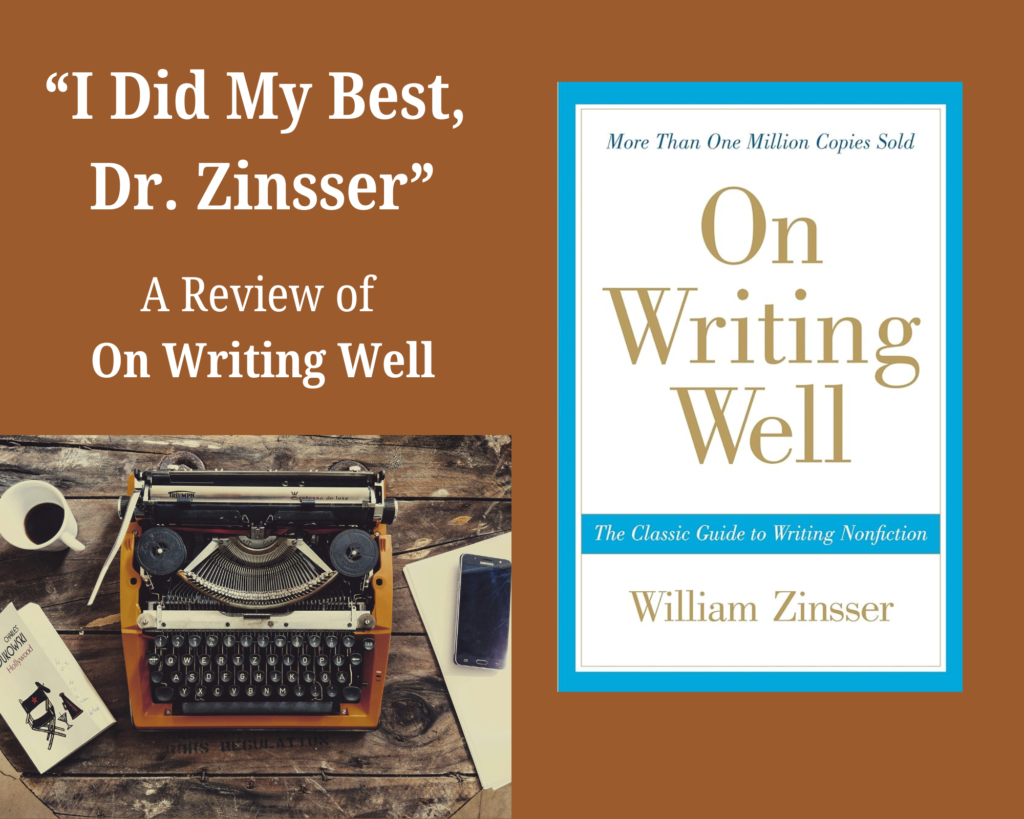
William Zinsser, writing professor and author of the million-copy classic On Writing Well, would probably tell you this sentence is too long. He’d also tell you the hardest decision any writer makes is how to begin a piece. “Your lead must capture the reader immediately,” he wrote, “and compel him to keep reading.” How am I doing? Another piece of Zinsser wisdom: fall in love with the process, not the end result. He once taught a writing class in which he did not require students to hand in any writing because “this fixation on the finished article causes writers a lot of trouble.” He wanted them to throw off “the tyranny of the final product” and experience the subtler gains of “learning, wisdom, growth, confidence, [and] dealing with rejection.” It’s not all about the grade or, for professional writers, the check. Speaking of the final product, Zinsser thought most writers go on for too long. “If you have presented all the facts and made the point you want to make,” he urged, “look for the nearest exit.” He backed that up in an annotated tour of his Condé Nast Traveler article about a trip to Timbuktu (yes, it’s an actual place). His whole reason for this junket was to witness the great Bedouin salt caravans completing their thousand-mile trek across the Sahara, culminating in a triumphant entrance into the city. Instead, having witnessed the caravans en route, the piece ends with Zinsser waking up from a dream about Lawrence of Arabia in a tent on a desert dune. “The realization that I could just stop was a terrific feeling,” he wrote, “not only because my labors were over—the jigsaw puzzle solved—but because the ending felt right.” On Writing Well is a pleasure to read in part because of the humor throughout. For example, this comedic burst comes in his chapter on writing about places: Nowhere else in nonfiction do writers use such syrupy words and groaning platitudes. Adjectives you would squirm to use in conversation—“wondrous,” “dappled,” “roseate,” “fabled,” “scudding”—are common currency. Half the sights seen in a day’s sightseeing are quaint, especially windmills and covered bridges; they are certified for quaintness. Towns situated in hills (or foothills) are nestled—I hardly ever read about an unnestled town in the hills—and the countryside is dotted with byways, preferably half forgotten. In Europe you awake to the clip-clop of horse-drawn wagons along a history-haunted river; you seem to hear the scratch of a quill pen. This is a world where old meets new—old never meets old. It’s a world where inanimate objects spring to life: storefronts smile, buildings boast, ruins beckon and the very chimneytops sing their immemorial song of welcome. You can tell Zinsser’s having a good time, which underscores a tip he offers on the writer’s mindset. “Writing is such lonely work that I try to keep myself cheered up,” he writes, adding humorist S. J. Perelman’s advice: “The reader has to feel that the writer is feeling good. Even if he isn’t.” Pillars and Pointers When I think about the book as a whole, I see two themes as the twin pillars of Zinsser’s instruction. The first is the idea that, ultimately, the writer is the product. In other words, we must find our own way into a piece. Musing on travel writing, for example, he writes, “It’s not enough just to take your readers on a trip; you must take them on your trip.” In his chapter on family history and memoir, he recounts, “Many of the chapters in my memoir are about small episodes that were not objectively ‘important’ but that were important to me. Because they were important to me they also struck an emotional chord with readers, touching a universal truth that was important to them.” “When we say we like the style of certain writers,” he writes, “what we mean is that we like their personality as they express it on paper.” That’s certainly how I felt as I read Zinsser. I couldn’t help imagining (fantasizing?) what it would be like to sit in one of his writing classes (he died in 2015). The other pillar is related—to find the human element in whatever subject you’re covering. Take sports. Don’t bore us with statistics. Help us relate to our heroes. Give us some hint of what it feels like to catch a 40-yard pass or drive a Formula One race car. And if those are the pillars, Zinsser also offers plenty of specific, practical tips. Here are just a few: “Most adverbs are unnecessary.” On using dashes, he wrote they “will get you out of many tight corners.” “Your style will be warmer and truer to your personality if you use contractions.” “If you’re not a person who says ‘indeed’ or ‘moreover,’ or who calls someone an individual (‘he’s a fine individual’), please don’t write it.” “Relax and say what you want to say.” “Don’t worry about whether the reader will ‘get it’ if you indulge a sudden impulse for humor. If it amuses you in the act of writing, put it in.” “I Did My Best, Dr. Zinsser” The book is a masterwork, to be sure, and most nonfiction writers (plus quite a few fiction writers) would benefit enormously from it. In his final chapter, titled “Write as Well as You Can,” Zinsser tells writers 90 percent of writing well comes from “mastering the tools discussed in this book.” The rest comes from wanting it bad enough, he says, just like in sports or any other major endeavor. Zinsser inspired me, even in this review, to give it all I had—to go as far as I can with my talent. If I were handing this piece into him in one of his writing classes at Yale, I’d tell him, “I did my best, Dr. Zinsser,” and I hope he would enjoy reading it. On Writing Well is a fun read, and it’s a helpful read too (in part because it’s fun). What I
The One Book Every Writer Needs

If you’re a writer who is struggling or could use some inspiration, you could do a lot worse than making Steven Pressfield’s The War of Art your soundtrack for the next two weeks, or longer. Whether you listen to the audiobook (2.5 hours) or read it (170 pages), engaging this book might be the most important thing you do for your writing career. What’s It About? The War of Art: Break Through the Blocks and Win Your Inner Creative Battles is author Steven Pressfield’s manifesto (my term, not his) to artists of all types, and its message is especially applicable to writers. Fiction or nonfiction (Pressfield writes both), experienced or inexperienced, published or not, well-known or unknown, this book is for all writers. It’s sold over a million copies because of how widespread its utility is. Organized in three “books” (“Resistance: Defining the Enemy,” “Combating Resistance: Turning Pro,” and “Beyond Resistance: Higher Realm”), The War of Art is composed of brief, punchy chapters. “Punchy” is the right word, I think. As you read, it feels like the book is boxing, which is apt, because the whole thing is about our tangle with the enemy, namely, “Resistance.” Resistance is what foreword writer Robert McKee calls “that destructive force inside human nature that rises whenever we consider a tough, long-term course of action that might do for us or others something that’s actually good.” Pressfield says of Resistance, “We experience it as an energy field radiating from a work-in-potential. It’s a repelling force. It’s negative. Its aim is to shove us away, distract us, prevent us from doing our work.” The first part of the book describes Resistance—how it operates, what its tactics are, and so on. The second part covers what it means be a professional and beat Resistance. And the final section does indeed seem to enter a “higher realm,” per this part’s subtitle, covering concepts like the muse, dreams, miracles, the Self, and territory vs. hierarchy. Why I Love *The War of Art* So Much I think it was Michael Hyatt who said, “You can’t lose if you don’t quit.” That’s always stuck with me. If you can muster within yourself the energy to keep going, you’ll never lose. That’s a remarkable promise, and I think it’s true. For my money, the best resource out there to keep you going is Pressfield’s little book. That’s why I love it so much. Steven Pressfield wrote a guide to the art of keep going. [Tweet “The one book every writer needs: my take on Steven Pressfield’s *The War of Art* @chadrallen #amwriting #WritingCommunity”] As a writing coach, I can teach you how to write better. I can teach you how to grow an audience, find an agent, choose which form of publishing is best for you. It’s much more difficult for me to teach you tenacity, and tenacity is perhaps the most important quality for a writer to succeed. Pressfield’s provocative powerhouse of a book kicks you in the pants and tells you, “You can do this. Keep going.” Pure gold. Conclusion If you were to push me into a corner and demand that I tell you which book I wish I could give to every writer on the planet, honestly it wouldn’t be that difficult a choice. There are a lot of amazing books for writers out there, but as far as I’m concerned Steven Pressfield’s The War of Art gets the blue ribbon. Postscript Another thing I love about this book is its unexpected success. The book was a practical solution to a problem Pressfield had. He was tired of having the same conversation over and over again with writers. He recounts, “I said to myself, Steve, why don’t you just write this stuff out in book form. Then when somebody tells you that they know they can be a writer and they want your advice, you can just hand them the book and say, ‘Here, read this.’” So he sits down, the book flows out of him in two months (because he’d spoken its message multiple times before), and it has sold over a million copies. The book may have been an effort to get aspiring writers off his back, but make no mistake: The War of Art is an act of generosity, as all the best writing is. It was the solution to Pressfield’s problem, but it also addressed a problem many readers have. Here’s the takeaway: Note how successful books can be when they solve real problems real people really have. Such books tend to market themselves by word of mouth. That certainly has been the case for The War of Art. Have you read The War of Art? If so, what did you think? And what’s one of your favorite books for writers?
On Becoming a Writing Coach
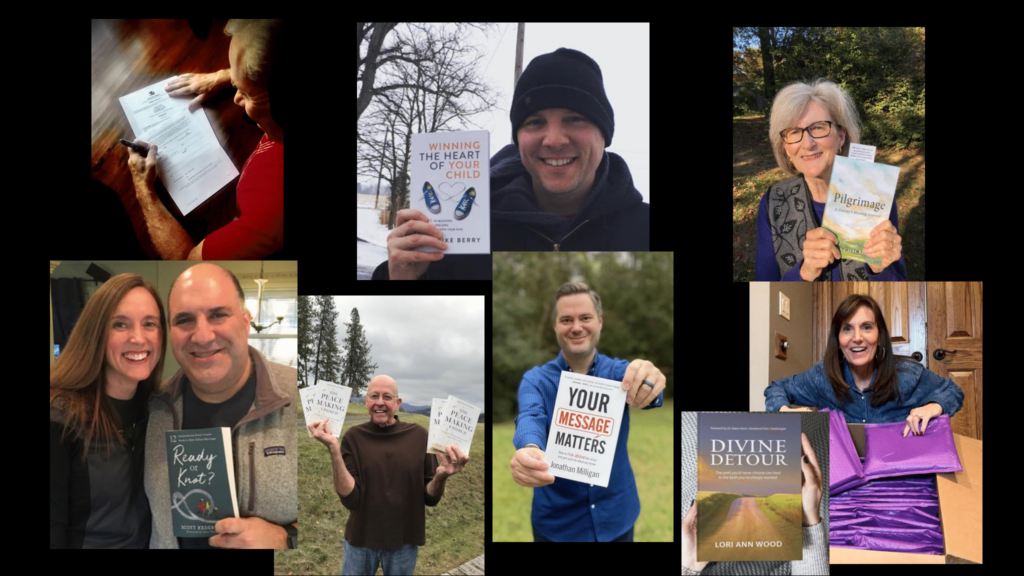
This past May (2023) marked five years of fulltime self-employment as a writing coach. I’d like to mark the occasion by sharing some reflections on my experience so far. Listening to Clients and Customers When I went out on my own in 2018, I had three main products I’ll list below in the order I started them: Book Proposal Academy, a standalone digital course One-on-one coaching, a higher-priced and higher-touch service BookCamp, a lower-priced subscription-based training center and community for writers I started all three while still in my corporate job with a traditional book publisher. As I made the transition to self-employment, I thought my main focus would be to grow BookCamp. It seemed to me the most scalable product of the three. I was also open to representing authors as a literary agent, helping them pursue book deals. But it became clear over the first couple years I was more of a coach than an agent. I did some agenting, and helped land a small number of book deals, but the coaching side of the business has always been more robust. Mind you, agenting involves quite a lot of coaching, but it’s a fundamentally different business. Honestly, I like coaching more. Agents serve a really important role in the traditional publishing industry. If you want a book deal, I strongly encourage you to pursue representation. But in terms of my own sense of vocation, there’s a lot about the agent role that reminds me of my work as an acquisitions editor. Agents say no a lot, for example, like acquisitions editors do. They have to; otherwise they’ll spread themselves too thin to help their existing clients. But as a coach, particularly inside BookCamp, I get to say yes over and over and over. I get to work with a writer from the very beginning of the process all the way to when they’re holding their published book and beyond. I’m not saying I’ll work with anyone, but I am saying the main criterion is determination. If you’re a writer who is determined, who’s willing to put in the effort and not give up, I can help you get to where you want to go. The other thing I enjoy as a coach that I didn’t get to do as an acquisitions editor and wouldn’t get to do to the same extent as an agent is help writers grow their platform/audience. Helping writers get the audience their work deserves is so gratifying. Here are my main products, currently: Book Proposal Academy I launch Book Proposal Academy once or twice a year, typically, with the occasional micro launch to a partner’s audience. This is pretty much what I was doing five years ago too, but we’ve made a lot improvements to the course. It now includes separate modules for children’s and fiction authors, for example, as well as a module on pitching and query letters and one sheets. We started with a small number of sample book proposals. Now we have a growing library of over twenty deal-winning proposals! Plus, we’ve recently improved the look and navigability of the course. I’m super proud of it. One-on-one Coaching When I started one-on-one coaching sometime in 2016 or 2017, the price was $150/month; now it’s $1000/month. This program includes a monthly video call, but it also includes editorial assistance, and I quickly learned the editorial work can be time-consuming, which is why I kept raising my rates. I provide a high level of service to a small number of one-on-one clients, and that seems to work well. BookCamp BookCamp is my main focus day-to-day. For a small monthly fee writers can join and go on the journey with us from establishing a writing habit to launching and promoting their book. Just saying that gives me a rush. Here’s a picture—a map, if you will—of the journey we take together: I love BookCamp. I love it so much that when I start talking about it, I quickly go from sharing about its features to randomly saying, “I love BookCamp!” The community we’ve built over the years is something very special. Leading this community is my job, but it’s also an honor and a privilege. As just one example, I’ve been hosting a BookCamp coworking session most Mondays at 11AM ET for at least a couple years now, and it is just the best way to start my week. I love BookCamp! The Members Area and our offerings keep getting better and better. We now offer twelve coworking sessions per month, thanks to some very generous members. And I now pay two other writing coaches to help me with the monthly submission reviews (as a member, you can send in two pages of your material for a professional review every month!), which just adds to the breadth of service we give our members. I could go on and on—about our monthly Fireside Chats, our master classes, our interviews with experts, our virtual writing retreats, the amazing goodness that happens in our Facebook Group. And the books! My word! Our members are getting books into the world like crazy. Here’s just a few of them: Mastermind Groups Early in 2022 I started a Mastermind Coaching Group with a vision of working closely with a small group of (no more than ten) writers. We meet twice a month, and our meetings have three main components: Accountability for the goals members set for themselves, Guidance both from me and members, and Encouragement The first group quickly filled up so I started another group, which is almost full as well. I’m now talking with a writing coach friend about the possibility of offering a third group that meets in the evening (the current groups meet during the day in the Eastern time zone). The bond that happens in these groups is remarkable, and it’s a joy to lead them. I’m excited to chase these writers’ books into the world right alongside them! Client Work Another significant part
How to Unlock Your Full Potential

You’re likely aware of Robert Frost’s poem “The Road Not Taken.” The poem ends with the famous line “I took the one less traveled by, / And that has made all the difference.” Nice idea. The problem is that the narrator of the poem knows full well the path he took was “worn really about the same” as the other. It’s a poem about how we embellish our decisions, making them sound better than they were. I thought of this recently as I reflected on how I make progress in my life and work. It happens in two ways. I’ll call them the micro way and the holistic way. Micro Way The micro way is all about changing “one little thing.” That’s often how I’ll ask the question to myself: “What’s one little thing I can do to lose weight?” for example. What’s one little thing I can do to . . . . . . get more done each day? . . . to write a chapter each week? . . . to increase the number of books I read this year? . . . to improve my relationship with my son/daughter/spouse/sister? Sometimes the best way for me to make progress is to pick one little thing to try. An experiment. I wrote about one of these here. The micro way is all about the idea “small hinges move big doors.” What’s one little thing I can do to effect change? That’s the micro way. Holistic Way Then there’s this other way I’ve noticed change take root in my life. I call it the holistic way. The holistic way is not about picking one little thing but rather picking a mode or pattern or paradigm. Instead of thinking about a single choice, I think more in terms of “stepping into” a new mode. Let me give you an example. When I recently went on a vacation with my family, I let loose with my exercise and nutrition choices. While on vacation I stopped thinking about that stuff. I just had fun, and I’m glad I did. But when I got back home, I noticed I was acting like I was still on vacation. Decisions that were healthy while I was on vacation (because I was on vacation) now started to look unhealthy. So I realized, “Oh, I need to step out of vacation back into work mode,” except “work mode” doesn’t do it for me. I like “achievement mode” or “thriving mode” much better. [Tweet “Micro or holistic? What’s your path to unlocking your full potential? Here’s help from @chadrallen #amwriting”] In the holistic way I’m less concerned about an individual discipline or experiment or choice and much more concerned about my mindset. I know if I get my mindset right, multiple choices will naturally follow. Thinking in musical terms helps me. The micro way is like picking a single new note to play on the piano. The second is like picking a different song to groove to. A chart: The Micro Way The Holistic Way One little thingDetails Microscopic Try an experiment Microcosm Musical notes ModePattern Paradigm Macro Whole Melody How to Pick Hearkening back to the Frost poem, I’ve noticed one way is not better than the other. They are just two different ways to find my way to desired results—be it lower weight or more money or better art or whatever. So how do you know which approach to adopt at this point in your life? I naturally lean toward the micro way first. If that works, I’m all set. If not, adopting the holistic technique usually does the trick. So, what about you? What do you need right now? The Micro Way or the Holistic Way?
The Art in Our Flaws

Sometimes when I’m working with writers, a question comes along that pierces me. I was leading a group of writers a little while back when one of the participants wrote in the chat space: “I struggle with making myself write—even a little—when I don’t have something I think is of any value. How do I overcome the need to write something ‘good’ or not write at all?” That hits hard, probably because I can relate to it. The part that gets me is “I don’t have something I think is of any value.” I realize this writer is probably referring to a single moment in time when the words or the ideas just aren’t flowing. We’ve all been there. But this writer is also pointing to a broader problem. Fundamentally, many writers struggle with a sense of worthlessness. We struggle with feeling like we have nothing of value to offer. That thought’s like a daisy-cutter bomb to creative work. What do we do with it? Well, first, we need at least to acknowledge the truth that we as people do have value—each of one of us. That is so basic it sounds somewhat ridiculous to say it. Yet it needs to be said. You are worth so much. You’re the only you. And if you don’t believe that in any given moment, ask the people around you to remind you, and ‘fake it till you make it’ because it’s true. From there I have just a few bits of advice. What’s obvious to you is not obvious to others. Think about this. The Population Reference Bureau estimates 117 billion humans have ever existed—117 billion. Think of all the experiences and stories that make up each and every one of those lives. It’s endless. It’s literally an infinite number of happenings and learnings and livings. And now think of the specific knowledge each person accrues in a life. You, because of your own set of experiences, know things you take for granted, but these are not things a lot of other people grasp. What’s needed is a bridge from your mind to others’ minds. Your writing is that bridge. Write, even if what you’re writing seems obvious, because it’s not obvious to others. Writing’s not the thing, rewriting is. No less a writer than Ernest Hemingway said, “The only kind of writing is rewriting.” The whole point of writing is not writing, it’s rewriting. Writing is just something to get through. You have to push through it to get to the real thing. If you let whatever forces you’re facing, within or without you, to sabotage the writing part, you never get to the rewriting part. And that’s where the juice is. [Tweet “The art in our flaws: a writer’s guide to beating perfectionism @chadrallen #amwriting”] “Become all flame.” Ever heard of the Desert Fathers and Mothers? These were people who in the fourth and fifth centuries moved away from the cities to live in the desert, where they could practice their faith in a purer way than was possible in the city. You can think of them as the first Catholic monastics or the harbingers of monasticism. Their surviving writings are really just scraps, or at least they read that way. Just little snippets of wisdom left behind from these wayfaring souls. And a common form in these scraps is the Q & A. A younger monk asks an older monk a question, and the older monk answers. Here’s my favorite: Abba Lot went to Abba Joseph and said to him, “Abba, as far as I can I say my little office, I fast a little, I pray and meditate, I live in peace as far as I can, I purify my thoughts. What else can I do?” Then the old man stood up and stretched his hands toward heaven. His fingers became like ten lamps of fire and he said to him, “If you will, you can become all flame.” Abba Joseph understood the idea of different planes of existence. All of them have their place. But sometimes, like the old man, we have to rise above our lesser voices. Sometimes we get so bogged down by our need to write something good we forget the first obligation of any writer. It is not to write something good; it is to write. Rise above. Become all flame. Let us begin . . .
How I Achieved Greater Happiness with One Simple Phone Trick

In The Psychology of Money, Morgan Housel reports on the work of Angus Campbell, a psychologist who studied what makes people happy. Campbell wrote, “Having a strong sense of controlling one’s life is a more dependable predictor of positive feelings of wellbeing than any of the objective conditions of life we have considered.” Housel summed it up: “Control over doing what you want, when you want to, with the people you want to, is the broadest lifestyle variable that makes people happy.” (This is from chapter 7 of his book, by the way, if you’d like to check it out.) I’m not sure why, but when I read this, I immediately thought not of the pressure to make money or follow through with obligations to which I commit myself. I thought about my phone—specifically, the extent to which my phone steals my ability to control my life. I had become very accustomed to checking three apps anytime I had some downtime, was bored, or just wanted a diversion. The three apps are: Email Facebook Twitter For some reason, after reading Housel’s bit on happiness, and without thinking about it much, I removed these three apps from my phone. It took less than a minute to do this, and the results have been revolutionary in my life. What do I mean? I’d like to use this blog post to chronicle some of what I’ve learned both to cement these learnings in my own consciousness and to share them in case they might be helpful to others. Slower Pace Life seems less hectic. If my “hectic meter” was at 8 before, it’s now at 2. It’s so strange to say this, but life seems to move at a slower pace. This is absolutely astounding to me. At first, I used the word “disruptive” to describe the effect of removing these apps. It was jarring. But over the course of two weeks I started using the word “revolutionary,” a much more positive word. This development is due, I think, to the fact that a change like this involves both loss and gain. I think I had to go through the loss of these apps to get to the unfathomable benefits on the other side. More of My Time I have more control over my time. One significant area where I’ve noticed this is in the morning. I like to spend the morning writing, reading, and meditating. But often these apps would hijack my morning ritual. I’d get caught up in app land, then look at my watch and realize, “Oh shoot, I need to get ready for my first appointment!” and I’d have to rush off without doing what I actually wanted to do. Without these apps, I find myself sticking to my ritual with much less difficulty. It’s not just mornings that have improved. In the first few days after deleting these apps, I had several moments where, when I would normally pick up my phone and engage with one or more of these apps for who knows how long, instead I picked up my phone, looked at it, and then set it back down. Honestly I felt a little defeated, sad even. I recall thinking, “There’s not much for me to do on that thing.” I might check the weather or do the Wordle for that day, but that was about all I could think to do. That’s what led to another pivotal development. Thinking My Thoughts, Feeling My Feelings Without something to do on my phone, I was left to think my own thoughts and feel my own feelings. What I realized is that for years my phone acted as a smokescreen for my thoughts and feelings—a diversion from myself, essentially. Now I have no choice but to actually think some things! One time I recognized feeling tired, so I took a 25-minute nap—a nap that would not have happened otherwise. I would have spent at least 25 minutes scrolling, fretting, whatevering. Not a Bed of Roses My addiction to these apps continues, of course. It was only a few days after removing my email app that I realized I could access it via my Chrome browser app. But it’s pretty clunky and involves another step or two, so at least to this point it hasn’t been nearly as consuming as the app was. I’ve thought about removing the Chrome app too; I haven’t yet. Two more lessons. In Praise of Books I’m reminded of the life-changing power of books. All of what I described above took place because of Morgan Housel’s book. I doubt Housel wrote it with the intention of helping people remove apps from their phones, but I bet he’d be glad to hear it. Anyway, my point is just that books change lives. Books change the world. Yay for books! Try Stuff Finally, this experience reminds me that when it comes to living well, it’s important to try stuff. I’m still astonished that this world-shattering experience was the result of actions that took me less than a minute to do. I mean, isn’t that unbelievable!? And it has me wondering: “Good Lord, what else can I try?” or “What else would take not much time to try?” Do I hope that people reading this article will remove apps from their phone? Well, sure, if it would help them. But my journey is not your journey, and I wouldn’t be so presumptuous as to prescribe what you need to do in your life. What I do hope is that maybe this piece will inspire you to try something—something slightly crazy, even—to improve your life. If someone were to write to me after reading this and tell me about something they tried that improved their happiness, that would be wonderful. [Tweet “How I achieved greater happiness with one simple phone trick that took less than a minute #writingcommunity”] Recalling that one of the most reliable determinants of happiness is control over your life, is there something you
How to Write a Useful Book That Markets Itself
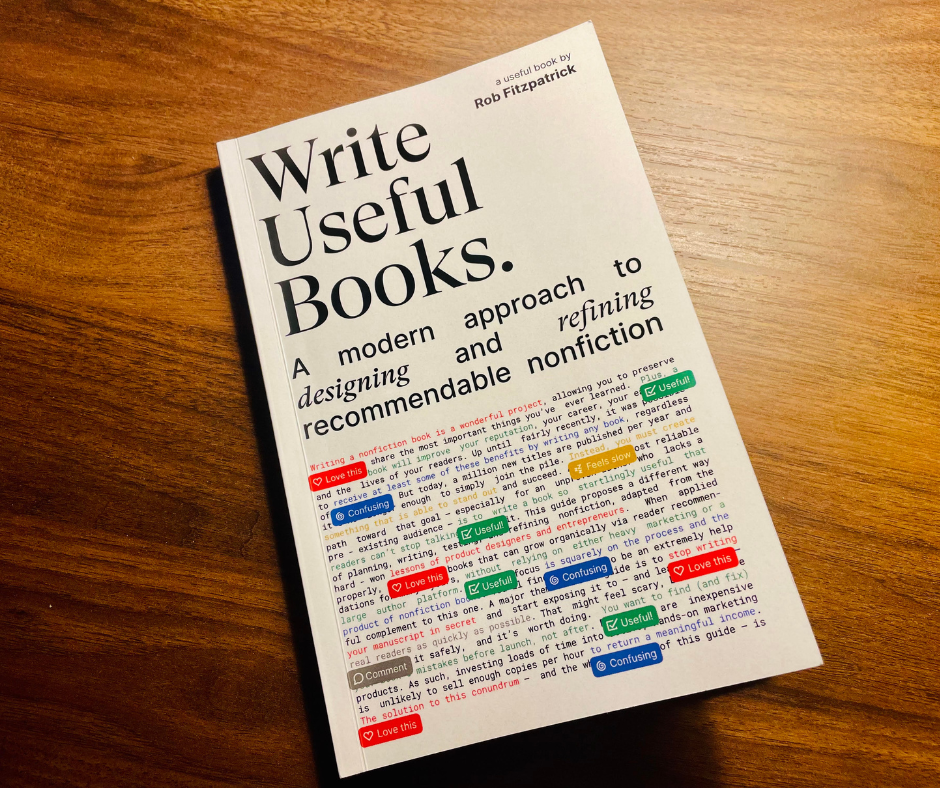
Do you know what’s even better than a great book? A great book that recommends another great book! That’s exactly how I came across Write Useful Books: A Modern Approach to Designing and Refining Recommendable Nonfiction by Rob Fitzpatrick. AJ Harper recommends it in her masterful Write a Must-Read. As soon as I finished Harper’s book, I picked up Fitzpatrick’s and promptly devoured it. It is mainly for nonfiction writers, though some of the content about publishing and optimizing for sales may be helpful to fiction writers. At 135 pages, Write Useful Books can easily be read in a few sittings, but don’t let that fool you. This book is packed with value. In this blog post I’ll share a summary of the book, what makes it unique, and my take on which writers will find it most, well, useful. Marketing Optional Fitzpatrick’s goal is to help you write a book that is so useful, it markets itself. “For properly designed nonfiction,” he writes, “ongoing marketing becomes an option rather than an obligation.” How’s that for a promise!? And he has the experience to back it up. Fitzpatrick shares sales data from his own three books, and all three have a history of picking up steam on the strength of word of mouth. That’s how “marketing becomes optional,” by the way—by writing a book with “long-lasting recommendability.” Fitzpatrick aims to show you how. Readers, Your Allies The main thing that sets Fitzpatrick’s book apart from other books for writers is his guidance on when and how writers should solicit feedback from readers. He opens chapter 3 by asking you to imagine a builder who’s designing a house for a family, but before consulting with the family the builder just dives in and starts building. “As absurd as it sounds,” he writes, “that’s exactly what most authors do with books. They write in secret, piling up a manuscript’s worth of beautiful words and only then start figuring out whether people want it….” Write Useful Books teaches you how to get feedback from readers as you develop your book’s concept and structure, and throughout the writing process. Ultimately Fitzpatrick helps you implement an iterative process of obtaining and incorporating feedback from readers, which is what produces a book that solves a real problem your readers have. If your book helps readers solve a problem they have, they’re very likely to recommend it to others. Marketing and Money The last two chapters are on how to find your first 1,000 readers and optimize for sales and growth. He covers four paths to marketing your book without favoritism for one path over another. Rather, he tells readers to pick the path that’s easiest for them. And in the last chapter he shares ways of increasing sales and generating more revenue from your book. [Tweet “How to write a useful book that markets itself: a review of @robfitz’s book by @chadrallen #writingcommunity”] Conclusion I strongly recommend Write Useful Books to anyone writing self-help, business, or another type of prescriptive non-fiction. And in so doing I’m providing evidence that Rob Fitzpatrick has written a truly useful book! What’s the problem your book solves?
A Writer’s Guide to Desire

My latest obsession is the Broadway musical Dear Evan Hansen. I like the show for a lot of reasons, but here I want to focus on how well one scene captures a particular feeling with which many of us are familiar. In one of the plotlines, the title character, Evan, is a lonely high school student who longs for the attention of another student, Zoe. For much of the story her affection seems like a hopeless impossibility, but then things change. In a song called “Only Us,” Zoe reveals her feelings to Evan. He doesn’t have to try to win her heart, she tells him. It’s already his. Here’s the scene from the movie version, starring Ben Platt and Kaitlyn Dever. This feeling of acceptance, and the desire for it, goes beyond romantic relationships. Congresswoman-elect Hillary Scholten’s recent victory speech here in Michigan’s Third District brought tears to my eyes in part because it included some of that same feeling. The subtext I heard in what she said was full of that sort of unexpected ecstasy: “You like me! You want me! You accept me!” A Writerly Desire Writers too have a fervent desire for acceptance. Writers want an agent to agree to represent them. They want a publisher to offer them a book deal. They want positive reviews. They want the affirmation of a growing audience. They want awards and bestseller status. They want the adulation of fellow writers. They want sales! When writers receive any of these kinds of acceptance, the resulting feeling can be intoxicating, eliciting a buzz that is right up there with requited love or winning an election! This desire is so strong among writers, I think it’s important to consider it carefully. Working with Desire Psychologists and mindfulness experts talk about how helpful it can be to “work with” a desire or craving. This idea of “working with” is empowering. It means essentially not just having an emotion but becoming aware of it, getting curious about it, and making deliberate choices about how to respond to it. Below I’d like to sketch out some tips that might be helpful to you as you work with this desire in your own life. Get Curious The desire for acceptance is real, and it’s healthy to notice it, to explore it a bit. Here’s a question to consider: In relation to what is this desire strongest for you right now? Is it related to landing an agent or book deal? Is it more about being recognized as an authority? Mind you, the desire for these things is not bad. On the contrary, it’s natural! Just notice it and try to understand it more. Beware the Strange Sometimes this desire for acceptance can make us do strange things—things that are not in keeping with who we are. It’s short-sighted to trade your integrity for what you think will garner the acceptance you crave. Your Part, Their Part We probably can’t (maybe we shouldn’t) get rid of this desire, but ultimately its fulfillment is not within our control. We cannot control, for example, how others will respond to what we’ve written. Lean into Generosity The desire for acceptance is not bad in itself, but it can divert a lot of energy away from the work we feel called to do. I’ve seen it become an obsession that sabotages writers. It can be a form of what Steven Pressfield calls “Resistance,” which is to say it can be a negative force that tries to stop us from fulfilling our dreams. One of the healthiest things we can do with this desire is to convert it into acts of generosity—the generosity of serving our audience. Ultimately that’s what writing is all about. Where do you notice this desire for acceptance in your writing life?