The Serious Business of Having Fun

Writing is emotional work in that people can respond to what you write in a way that actually hurts. This is worth pondering for a minute. Other kinds of work like, say, washing dishes or taking out the trash, are not the same. Sure, someone might point out a bit you missed on a plate, but typically you didn’t invest much of yourself into washing the plate. You might be annoyed, but you’re unlikely to be hurt in the way you will be if someone pans your book on Amazon. High Stakes In contrast to other kinds of work, in writing we have more to lose because we are exposing a vulnerable part of ourselves. The stakes are high. And because the stakes are high, we are prone to procrastination and escapism. It can be tempting to run away from our work into all sorts of negative, counterproductive diversions: Endlessly scrolling through social media (pick your poison: Facebook, Twitter, Instagram, Pinterest, TikTok) Surfing news sites for longer than anyone should Watching entertaining but unimportant videos Checking email incessantly Any of the 20+ addictions commonly recognized by the medical community Diversions like these may seem insignificant—just a few minutes here and there. But a few minutes here and there adds up, and sometimes a few minutes turns into a few hours or even days or… Creative Jiu-Jitsu This foe of creative work is real. In fact, having coached thousands of writers over twenty-five years, I think it is one of the most vexing enemies to creative work. We’re in a pickle. We want deeply to do the creative work from which we are constantly tempted to escape into counter-productive actions. What to do? Instead of trying to overcome your need for escape or diversion, I encourage you to collaborate with it. I call this “creative jiu-jitsu.” To this end I want to offer five practices to help you infuse more fun into your creative work. 1. The Myth of the Eight-Hour Work Day Historian Benjamin Hunnicutt said in an NPR interview that when humans were hunter-gatherers, we worked much less than eight hours a day. Fast-forward to the Industrial Revolution, which ushered in a period when a 70-hour work week was not uncommon. Fortunately, the labor movement with some paradoxical help from the Great Depression eventually got us down to 40-hour work weeks. My point: the eight-hour work day is made up. We invented it, and it’s become the norm. But is it realistic for writers? I don’t think so. I remember hearing Anne Lamott, beloved writer to writers, say that she writes about four hours a day. Ernest Hemingway shot for 500 words a day. I’ll just come right out and say it: Expecting yourself to write for eight hours in a day is in most cases unrealistic. Action step: Adjust the duration of your writing sessions. [Tweet “The serious business of having fun: 5 strategies for writers #amwriting #writingcommunity @chadrallen”] 2. Sprints Twice a year for the past couple years I’ve hosted a virtual writing retreat inside BookCamp, my mentoring and community hub for writers. In these retreats I use something called the pomodoro method, which involves writing for 20 or 25 minutes and taking a 5-minute break. You do this four times. After the fourth time, you take a longer break. Writers who participate are always so impressed by how much they can get done with this method. It works! Action step: Write in short sprints. 3. Little Breaks I’m a big believer in little breaks. But to be productive, little breaks do not involve social media or other addictive inclinations. Here are some examples of little breaks: Get a drink of water. Not tequila. Go for a walk or run. Wash your hands and splash water on your face. Eat a healthy snack. Shoot some hoops. Go for a coffee or tea. Stand up and stretch. Do a 5- or 10-minute meditation. Simply walk around your room a bit. Do a mini crossword or Wordle. You get the idea. These are simple, brief, life-enhancing breaks that give your mind a rest. Action step: Take little breaks while you’re writing. 4. Connect with Other Writers Writing is more fun when you’re able to connect with a community of other writers—to ask questions and share both your wins and worries. Some writing communities offer coworking sessions, where you show up and work on whatever you want while others do the same. Some have closed Facebook groups where writers can feel safe sharing their struggles or asking questions that non-writers may not even understand. And look for writing groups where you can get training from experts and connect live with other writers. Incidentally, BookCamp has all of these features and more! Action step: Find a community of writers. 5. Celebrate Your Wins! Question: when do you celebrate? I hope you celebrate your birthday and those of the people in your life. Perhaps on holidays? But what about when you just finished a draft of something you’ve been working on? What about when you show up to write every weekday? I’m always encouraging writers to lower the bar for what merits celebration. Celebrating is a key strategy for following through on your writing projects because doing so creates momentum. I tell writers to think through what celebration looks like. It could simply be a post that announces what you’ve accomplished. Getting those comments and thumbs up can be wonderful. Or celebration might look like an indulgence of some kind. One day I took twenty minutes to create a file I now keep on my laptop called “Rewards Brainstorm.” It’s a list of ways to reward myself, ranging from cheap things (“Dairy Queen Blizzard”) to more expensive things (“Take a trip to Chicago”) and in different categories like desserts, clothes, gadgets, entertainment, trips, and subscriptions. Because I struggle with rewarding myself, having this list helps me follow through on celebrating in meaningful ways. Maybe it’ll help you too. Action step: 1.
How to Defeat “Writer Overwhelm” Once and for All
Recently I surveyed writers about their biggest challenge, and the following response caught my attention: Some days . . . all of it. I feel totally lost at times. How do I build an audience, know my work is where it should be, decide which publishing path to pursue, know who is the right person to approach about editing my book, pick the right agent? Can you relate? Are you experiencing your own version of writer overwhelm? In this post I want to offer a way forward that I hope will reduce your stress and help you focus on the right next step. But first I want to address a matter of mindset that plagues many writers. Mindset Shift Writing a great book is a long-term project. You’ll come across a lot of people out there who want to convince you otherwise, but the reality is that writing a truly good book takes time. Similarly, building an audience takes time, and so does marketing a book. Often a lot of stress comes from believing all of this can be done quickly. It’s just not true. Sure, you can write and self-publish your book in a month, but I guarantee it won’t be that great, so what would be the point? Do you see how extending your timeline can reduce your sense of overwhelm? Mind you, this is not a reason to slack off or get lazy, but it is a reason to settle in, relax a bit, and start chipping away at the process one step at time. Three Areas of Focus You can boil the whole writing-to-publication process down to three areas of focus: Writing Marketing Publishing These are not hermitically sealed categories; rather, they blend and intertwine with each other. But when trying to decide what to focus on, it’s helpful to think of them separately. Many writers want to jump as quickly as possible to the publishing part, but if you want to have the biggest impact possible, it’s important to focus on writing and marketing for a while. Take solace in knowing that as you make progress on 1 and 2, you’re setting yourself up for 3. Now let me show you the steps my most successful clients have taken in each area. [Tweet “How to defeat “writer overwhelm” once and for all . . . #writingcommunity #amwriting “] Writing Steps When it comes to writing, here’s the process: Design a writing process that works for you and establish a writing habit. Decide when you’ll write your manuscript vs. marketing-related writing (e.g., blog posts). Start writing consistently. Develop your book concept. I’ve written about this here and here. Write your manuscript. Edit your manuscript. Marketing Steps When it comes to marketing, here’s the process: Begin growing your email list. Create a website. Publish content to serve your email subscribers on your website. Send an email to let your subscribers know when you’ve published something new. Shoot for publishing something at least once a month. Ideally you’d publish a new piece once a week. Keep growing your email list. Develop a plan for marketing your book as you prepare for its publication. Publishing Steps When it comes to publishing, here’s the process: Write a book proposal. This is helpful to do regardless of whether you pursue a book deal or self-publish or work with a hybrid publisher. Choose a path of publication. For a really good breakdown of the various avenues of publishing a book, see chapter 15 of AJ Harper’s Write a Must-Read, which you can download free here. If you’re pursuing a traditional book publisher, identify good-fit agents and/or publishers. Then submit! If you’re hybrid publishing, ask for recommendations, do your homework, ask lots of questions, and begin working with your hybrid publisher. If you’re self-publishing, after self-editing your manuscript, hire and work with a substantive editor. Hire and work with a copyeditor. Hire and work with an internal book designer. Hire a copy writer or use your proposal to write back cover and marketing copy. Hire and work with a cover designer. Publish! Launch and promote. Where to Begin? I recorded a brief video to help you decide where to focus so that you can defeat writer overwhelm in your life! As you read through the steps above, where do you need to focus in the coming days?
AJ Harper’s Gift to Writers
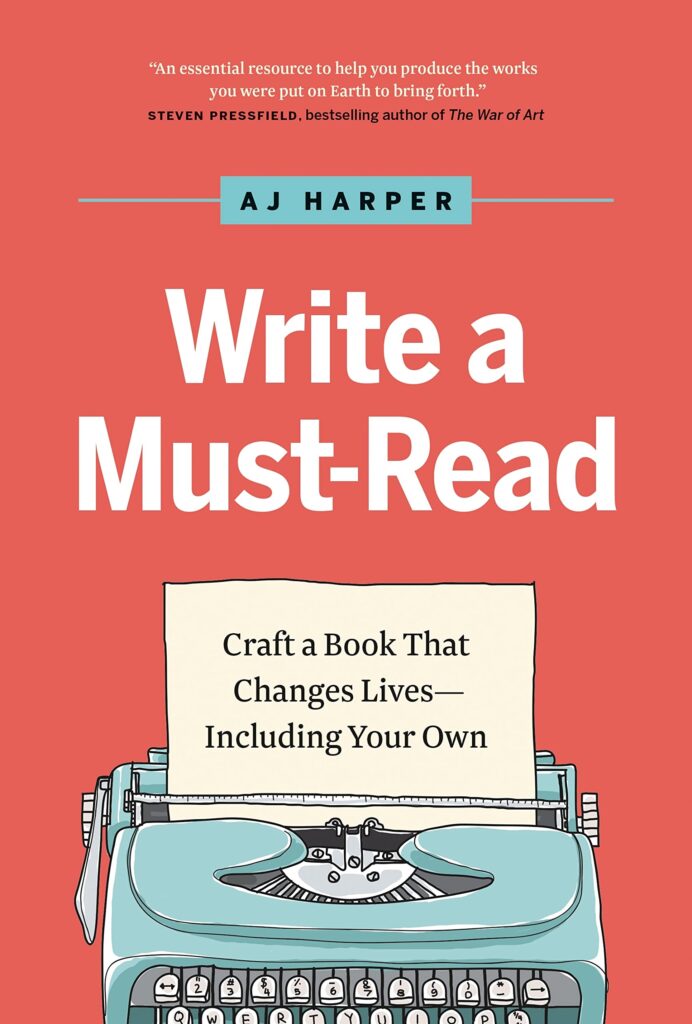
AJ Harper’s book is generous. But on her way to providing what many writers likely want—a thoroughgoing step-by-step guide to writing a truly great book—she has to do some disabusing first. In this market space of writing and publishing and book-marketing, a lot of experts talk about how easy and quick it can be to write a great book. AJ Harper, an editor, former ghostwriter, and longtime writing coach, steps into the fray and tells us like it is. “Writing a must-read book will take much longer than you imagine.” And later, in reference to editing: “As hard as you think it will be, you end up wishing it were that easy.” I know this can be tough to accept, but as I read these hard words, a part of me wanted to cheer. Harper tells us what we don’t want to hear but most need to hear. She doesn’t stop there, though. In fact, AJ Harper is the best kind of coach in that after telling you how hard the climb is, in the next breath she tells you, “You can do this. It won’t be easy, but you can do it!” Then she settles in, taking her place beside you to show every step of her “reader first” method of crafting a “top three” book—a book that finds its way to a reader’s list of their favorite three books. [Tweet “AJ Harper is the best kind of coach in that after telling you how hard the climb is, in the next breath she tells you, “You can do this. It won’t be easy, but you can do it!” #amwriting”] It is of course nothing new to remind writers to think about their readers. What’s unique here is how Harper’s method sticks doggedly with this mandate from start to finish of the book-making process. The detail Harper provides is one of the most distinctive qualities of Write a Must-Read. The book is full of meaty instruction followed by well-thought-out exercises for the writer to complete along the way. Organized into three parts, the first covers concept development; the second winsomely helps the writer complete her first draft; and the third is a tour de force on self-editing. One of the later chapters is a crash-course in publishing that alone is worth the cost of the book. For all its practicality, though, Write a Must-Read does not come off like an instruction manual. Harper’s stories and humor make this a really entertaining read. I laughed, and by the time I got to the very last chapter, in which she likens her son’s basketball journey to that of writers, I cried. I’ve read a lot of books for writers, and I can say without hesitation AJ Harper’s Write a Must-Read is itself a must-read for writers. How will your book serve its readers?
A Runner’s Advice to Writers

Running is a great metaphor for a lot of things, especially writing. As a writing coach who’s training for my first marathon (Chicago Marathon 2022, baby!), I see parallels all over the place. Often it can be helpful to get a fresh perspective on our writing lives, and I think running offers some really helpful guidance here. So, here are my five running tips . . . for writers! 1. Consistency Is Not Necessarily What You Think It Is My running coaches, Phil Mosley and his team at MyProCoach, make a point of saying not to worry too much if I miss a workout or a run. “It’s not the end of the world if you don’t complete ALL of the workouts,” Phil Mosley shared in an email. “To be honest, not that many people complete 100% of their plans (myself included). And not because they’re lazy. “It’s just that life gets in the way sometimes and you won’t always get the opportunity to exercise.” As a writing coach, I say very similar things to writers. Don’t worry about missing a writing session. Your writing career will not sink or swim based on a few missed sessions. Phil Mosley again: “It’s completely normal. . . Missing a session or two, now and then, is no big deal. “We all have jobs, families, responsibilities and commitments. Plus, we all get tired or ill sometimes.” What’s true for runners is true for writers. Crises and extenuating circumstances are to be expected, as is being tired every once and a while! But here’s the golden nugget in Phil’s advice: “The important thing to remember is that no single workout will make or break your training (whether you complete it or not). It’s more about what you do consistently, over a longer period.” That’s it, writers. Hitting every planned writing session is not the point. “It’s more about what you do consistently, over a long period.” We’re in a volume game. Show up as often as you can. Don’t sweat it if you miss a session. Just get back to your writing chair, if at all possible, the next day. If not, shoot for the next day. AJ Harper says in her wonderful book, Write a Must-Read, that your first draft is just math. A typical nonfiction manuscript is 50,000 words, so your first draft should be about 60,000 words because you’ll likely cut quite a bit. Divide 60,000 by how many words you plan to write in a session, and you have how many sessions it’ll take. If you keep at it, you’ll get there eventually. It’s just math. 2. Don’t Be Afraid to Ask for Help This is not my first attempt training for a marathon. That was last year, when I came down with a calf injury and had to settle for a half-marathon. When the injury happened, I made an appointment with my physical therapist (shout out to Dr. Jason Ross at Train Out Pain in Grand Rapids, MI). He examined my injury, figured out how much training I’d be able to do before the marathon, and delivered the bad news. He told me I could run the half, but running the full marathon would be risking permanent injury, which he had seen happen with other runners. These poor folks are no longer able to run, which is something they really enjoyed doing. Listen, I wanted to run a marathon really bad last year, but it wasn’t worth losing the ability to run altogether! This year I made an appointment early in my training. Dr. Ross gave me some exercises to help keep injury at bay, and I feel much better prepared for the marathon this year. Writers, ask for help! Definitely ask for it when you get stuck, but better yet, ask for it before you really need it. One word of caution here. Be careful who you ask. It’s important to seek out someone who has some experience. Ideally, they’d have some expertise with the kind of book you’re writing. The only thing worse than no advice is the wrong advice, so be sure to do your due diligence here. 3. Find Things to Enjoy This morning I put in a 40-minute strength-training workout of squats, lunges, push-ups, and more. Tomorrow I’ll do a 48-minute run that involves running up and down a hill multiple times. Next I get a day of recovery before my long run for the week, which will last 2 hours and 15 minutes. It’s tough work, which may be why less than 1 percent of Americans have completed a marathon. How many people have written a book? In one study, while half of respondents said they had an idea for a novel, only 8 percent had finished one. According to a self-identified scientist in a forum I visited, the actual figure of people who’ve completed a book is somewhere around one-third of 1 percent. Suffice to say, it’s a small number. And it’s no wonder. Like training for a marathon, writing a book is really hard! What to do with all this? Well, one thing running has taught me is to enjoy the process. The right tools help. For example, I love my new running shoes (Brooks Ghost, ftw), and I just purchased a nice lightweight running hat that protects me from the sun. On my long runs I need this special gel stuff to get enough calories. These items make my runs a lot more enjoyable, and the right writing tools make a big difference too. Your writing is worth some investments. To wit: A good computer, laptop, or Chromebook can make a huge difference. An inspiring book to read (here’s one I’d recommend) Journal (I bought this one on Etsy a while back and love it! Mine says “Every Step Matters” on the front.) A favorite pen (here’s mine) Ergonomic keyboard (here’s mine) Airpods! Coffee! I asked writers via social media what their favorite tools are, and quite a few showed up with suggestions! Here are
How to Write an Email to Promote Your New Blog Post, Podcast Ep, or Video

Once you’ve begun building your email list, it’s important to begin sending your subscribers useful content. This could be a blog post, a podcast episode, a video, or some other form of content. (A fun way to approach this is to geek out about the same things your audience likes to geek out about. Click here for more about this method of generating useful content for your followers.) Whatever the content you create, doing so at least somewhat consistently will help you build trust with your readers. I often tell writers the most reliable way to be a successful author is to serve an audience over time before your book releases. You do that with content you consistently deliver to their inboxes. [Tweet “The most reliable way to be a successful author is to serve an audience over time before your book releases. #amwriting”] Ah, but here’s the rub. What if your email reaches their inbox, but they don’t open your email or click within your email to go to what you’ve created? That’s the topic of this article, because if no one opens your emails, it’s as if you never had an email list to begin with. I’m going to share some practical ways to dramatically increase reader engagement with your emails and therefore your content. The first step is to come up with a great subject line. Develop a Compelling Subject Line for Your Email The vast majority of readers will decide whether or not to open your email based solely on your email’s subject line. I beg you not to use subject lines like: “New Post from James Smith” “Blog Post #32” “Writing tip #72” “Chad Allen’s 18th Newsletter” Subject lines like these will sabotage your open rates! Not quite but almost as bad are subject lines that use poetic or obscure language that doesn’t tell readers what the content is, such as: “Night Skies and Shiny Beetles” “Hope and Peace” “My Aunt Sandy’s Apple Pie” In short, who cares!? The best subject lines are focused on a benefit to the reader, such as: “5 super doable ways to develop more intimacy with your spouse” “A simple stress-relieving prayer for when you’re overwhelmed” “A checklist to make your date night awesome!” Notice in the above list my preference for sentence-style capitalization in email subject lines. I prefer title capitalization in my actual blog posts, but in subject lines I like the more casual sentence style because I think it’s more like what a friend would send to a friend. Below are three resources that will quickly help you improve your skill at developing subject lines. The article titles at Copyblogger. Copyblogger is a site dedicated to helping normal folks like you and me become better at writing stuff people will actually read. If I’m struggling with a blog post title or subject line (and in my case the two are often identical), I sometimes jump over to Copyblogger’s site and simply peruse their article titles. More often than not I find the inspiration I need. David Garfinkel’s Advertising Headlines That Make You Rich. This book is organized into twenty different headline templates. Again, a great source for inspiration. And finally, check out Coschedule’s tool, Headline Analyzer (you’ll likely need to create a free account to use it). Headline Analyzer assigns a score to any headline you’re considering. I always shoot for a score at least in the seventies. You may choose not to go with Headline Analyzer’s guidance, but it provides a useful reference point. Now that we’ve developed an attractive subject line, we need to make sure the copy of our email is just as attractive. [Tweet “How to Write an Email to Promote Your New Blog Post, Podcast Ep, or Video #writerslift”] Promote Your Content Let’s assume your subject line prompted a subscriber to open your email. Job #1 complete! Job #2 of your email is to help your subscriber see how your content is going to help them. Ultimately, we want them to click on a link we provide so they can take advantage of our content. You might ask, “Why shouldn’t we simply include the content within the email?” I think this is fine, but it’s often helpful for your content to be in a public place that lasts a while and can be shared with others via social media. I love getting emails from my audience; what I love even more is when they comment on my site or share my content because then more people can join the conversation. That’s why I typically link to (for example) my new blog posts rather than simply copying and pasting it into the email I send. So how do you craft an email that motivates your readers to click the link you provide. It comes down to five primary elements. I’ll share the elements and then a sample email that puts them to use. Start with the problem your content solves. Often a great way to do this is with a question. Agitate the problem a little bit. You don’t need to go overboard, but point out the real loss that’s involved if your reader does not solve the problem you’ve just raised. Segue. Simply let readers know that you’ve created something that will solve their problem. Provide a list of benefits. Touch on the high points of what the reader will get from your new content. I often do this in bullet form. Try to write these in a way that’s surprising and unique. Insert the link. I like to hyperlink a verbal call to action such as “Click here to find out how to write an irresistible email.” For example, the email I use to promote this blog post might go something like this: Hi Friends! Do you wish more people opened your emails and engaged with your content? [Problem] You spend a lot of time creating great content, but if no one engages with it, it feels like, what’s the
25 Motivational Quotes for Writers

If you’re like many writers, you began this year with some goals in mind. You were determined to finish your manuscript or start your website or submit your book proposal or grow your audience. How is it going? Maybe you’ve made some progress but not as much as you wanted. Maybe you haven’t made much headway at all. If you can relate to this, I want to offer some hope. I’ve compiled twenty-five of what I think are the most inspiring quotes for writers. I hope these are helpful to you! Consider printing them out or copying one down and posting it in a place you’ll see from time to time. 25 Motivational Quotes for Writers 1. “It always seems impossible until it’s done.” —Nelson Mandela 2. “Be fearless in the pursuit of what sets your soul on fire.” —Unknown 3. “It’s not fun to fail, but it just might be the only way to succeed.” —Jeff Goins 4. “Everything got better for me when I made peace with the fact that it might not ever get easier . . . Creative work is hard. Life is short and art is long.” —Austin Kleon 5. “Every step matters.” —Anonymous 6. “If at first you don’t succeed . . . you’re normal.” —Michael Hyatt 7. “You should be far more concerned with your current trajectory than with your current results.” —James Clear [Tweet ““You should be far more concerned with your current trajectory than with your current results” and 24 more quotes for writers #amwriting”] 8. “You make a living by what you get. You make a life by what you give.” —Winston Churchill 9. “Everything gets harder if you start going on and on about how hard it is.” —Stephen Covey 10. “Your goals should be in your discomfort zone. Your next steps should be in your comfort zone.” —Gail Hyatt 11. “Our greatest weakness lies in giving up. The most certain way to succeed is always to try just one more time.” —Thomas Edison 12. “A man without a goal is like a ship with no rudder.” —Thomas Carlyle 13. “There’s a secret that real writers know that wannabe writers don’t, and the secret is this: It’s not the writing part that’s hard. What’s hard is sitting down to write.” —Steven Pressfield 14. “What single brave decision do you need to make today?” —Michael Hyatt 15. “Alone, we can do so little; together, we can do so much.” —Helen Keller 16. “Good ideas come from bad ideas, but only if there are enough of them.” —Seth Godin 17. “Failure is an event, not a person.” —Zig Ziglar [Tweet ““Failure is an event, not a person” 25 motivational quotes for writers #writingcommunity”] 18. “Pick battles big enough to matter, small enough to win.” —Jonathan Kozol 19. “Writing can be a very dramatic pursuit, full of catastrophes and disasters and emotion and attempts that fail. My path as a writer became much more smooth when I learned, when things aren’t going well, to regard my struggles as curious, not tragic.” —Elizabeth Gilbert 20. “What is now proved was once only imagined.” —William Blake 21. “Art is the generous act of making things better by doing something that might not work.” —Seth Godin, The Practice 22. “The first draft is just math.” —AJ Harper 23. “Tend your own garden, and love what grows within.” —Anonymous 24. “If you want to be a writer, you must do two things above all others: read a lot and write a lot. There’s no way around these two that I’m aware of, no shortcut.”—Stephen King 25. “Courage doesn’t always roar. Sometimes courage is the quiet voice at the end of the day saying, ‘I will try again tomorrow.’” —Mary Anne Radmacher Which of these quotes do you find helpful today?
A Powerful Thing to Remember When You’re Stuck
Recently I joined a gym. Well, I say a gym. It’s actually a nearby high school’s fitness center that’s much cheaper than other gyms and is just 7 minutes from my house. I joined because I want to train for my first Olympic-distance triathlon, and I need a place both to swim and to cycle during the winter months here in West Michigan. My official training starts in a few days so yesterday I dropped in to get a tour of the place and get a cycling workout in. If up to this point you’ve been hearing gentle music playing in the background of this story, now is when you’d hear a loud scraaatch and a beat of silence. Because when I went in, I learned the only exercise bikes this fitness center has require an extra $5 per use and have very restricted availability. I’m embarrassed by how rattled I was by this. I was frustrated, afraid, and angry all at the same time. And so goes the writing life. We get to work on a project and we encounter an obstacle. All the agents and publishers reject our proposal. Our lead magnet doesn’t work. Nobody commented on our blog post. Something happens in our family that upends everything. We wake up one morning and realize it’s been two months since we made any progress on our manuscript. The list goes on and on. But here’s the thing. As long as I stick with my goal of completing this triathlon, I’ll figure out how to do my training. As I write this I don’t know how, really, though I have some ideas to try. The key is not to give up and to remember that encountering obstacles means you’re doing something! You’re on your way. We have only to look back to remind ourselves nothing has ever happened that we haven’t been able to figure out. No problem has been so difficult we weren’t able to solve it. That’s the case with this obstacle too, whatever it is. Hang in there. Remember how far you’ve come. And don’t give up. You’re going to figure this out.
Best Books for Writers on Craft, Creativity, Marketing, and More!

Reading the right books can help you become a better, more successful writer, but where to start!? I’ve been an avid reader of books for writers a long time now, and it’s a topic I’ve written about in the past. But as I keep reading more books in this genre, I expand and refine my list of recommended books. In this blog post I’m going to spotlight my favorite books for writers in the following categories: Inspirational Books for Writers The Craft of Writing The Writing Life Creativity Book Marketing Here we go! Inspirational Books for Writers The winner in this category is easy: Steven Pressfield’s The War of Art: Break Through the Blocks and Win Your Inner Creative Battles. It’s short. It packs a punch. And I can pretty much guarantee you won’t walk away from this book without being changed for the better. I’ll mention two more inspirational books for writers. The first is Seth Godin’s book The Practice: Shipping Creative Work. Sometimes focus so much on outcomes, we need someone to stress the importance of staying on the journey. This book is that someone. And finally, several years ago I wrote a short book called Do Your Art: A Manifesto on Rejecting Apathy to Bring Your Best to the World. Creativity expert Todd Henry said this about it: “Chad’s manifesto delivers a simple but profound truth: you have unique art to offer the world, and deliberate action is the only path to making it happen. A wonderful (and welcome) kick in the pants!” The Craft of Writing In my opinion, the best book to help you improve your writing skills is William Zinsser’s On Writing Well: The Classic Guide to Writing Nonfiction. It is standard issue in newsrooms throughout the country for a reason. It’s that good, and it’s also quite entertaining, which of course is part of why it’s so good. Fiction writers have much to gain from Zinsser despite what the subtitle suggests, but for a book more directly focused on fiction, see Sol Stein’s Stein on Writing: A Master Editor Shares His Craft, Techniques, and Strategies. One of the things I love most about this book is how many examples Stein includes. A book that more recently hit my radar is Writing Tools: 55 Essential Strategies for Every Writer by Roy Peter Clark. I’m about halfway through it, and I can tell you it’s very, very good. The chapters are short, which makes it easy to use as a daily reader if you’d like. Each chapter is about a very practical and well-illustrated tactic. Another book that will help you improve your writing is Write Better: A Lifelong Editor on Craft, Art, and Spirituality by Andrew T. LePeau. I liked it so much, I used it for a multisession master class in BookCamp. Uniquely, LePeau writes this book from a Christian worldview, which does not mean the book is only for Christians. But this approach frees the author up to include a helpful section on the spirituality of writing. And finally, I can’t sign off on a collection of books about the craft of writing without mentioning The Elements of Style by William Strunk Jr. and E. B. White. Another classic, this slim volume is a fast read, full of wisdom. The Writing Life Admittedly, the lines get blurry between books on craft and books on the writing life. You’ll find plenty of practical writing tips in the books I’m sharing today. But the emphasis in these books is on what it’s like to be and how to thrive as a writer. It’s really difficult for me to pick a single favorite in this category, so I’ll pick two: Anne Lamott’s Bird by Bird: Some Instructions on Writing and Life and Stephen King’s On Writing: A Memoir of the Craft. Lamott is laugh-out-loud funny, and she does such a great job of normalizing all the usual fears writers face. Stephen King’s book is riveting. as you’d expect. There’s one particular scene in which King describes the moment his fortune as a writer changes, and it’s spellbinding. You’ll love it. Two other books deserve to be mentioned here. One is Natalie Goldberg’s Writing Down the Bones: Freeing the Writer Within, which presents a Zen approach to writing. I find her breezy, vulnerable writing so compelling. And then there’s Jeff Goins’ Real Artists Don’t Starve: Timeless Strategies for Thriving in the New Creative Age, the most recently published of this collection. Jeff’s a friend, and he told me the book was really just an excuse to share a bunch of stories he likes to tell. Well, the stories are wonderful, but it all holds together really well too. Creativity Books about creativity—how to live creatively, how to maximize one’s creative output, etc.—are among my favorite books to read. Todd Henry’s The Accidental Creative: How to Be Brilliant at a Moment’s Notice changed my life. Reading this book was the first time I encountered the idea that I could live in a way that facilitated my best, most creative work. Todd, who since has become a friend, not only explicates this idea; he provides a method for living it out. Elizabeth Gilbert’s Big Magic: Creative Living Beyond Fear is a wonderfully rich read, and perhaps more narrowly focused on the work of writers. Gilbert’s a master storyteller. You find yourself swept up in her narratives as you glean lessons that powerfully enrich your creative life. I love Austin Kleon’s three little books, Steal Like an Artist, Show Your Work! and Keep Going. They’re in a smaller format than typical trade books, very fast reads, and full of all kinds of engaging art. Fun! Have you heard about Brian Grazer’s A Curious Mind: The Secret to a Bigger Life? Grazer is Ron Howard’s business partner and has helped produce such films as Splash, 24, A Beautiful Mind, and Apollo 13. One reason this book is so great is because you get to live vicariously as Grazer interacts with such people as Mick Jagger, Princess Diana, and Isaac Asimov. But I love the practical suggestions in this book too, including what he calls “curiosity conversations.” Finally, a children’s book deserves mention here. Kobi Yomada’s What Do You Do with
Get Solid Endorsements for Your Book with This 5-Step Process

As readers we’ve likely relied on endorsements for own book choices, so we get how important they are. Endorsements serve as third-party votes of confidence for your book. They lend credibility and reliability to what you’ve written. So, how do you get them? In this article I’m going to share five steps that just about anybody can follow to obtain great book endorsements. Step 1: Finish your manuscript. You don’t need to send a final set of proofs to your endorsers, but ideally you have a complete manuscript that has been copyedited. Even if the endorser knows and likes you, they may be reticent to provide a blurb if the manuscript they receive is unfinished or in rough shape. [Tweet “”Get solid endorsements for your book with this 5-step process” #amwriting #askeditor @chadrallen”] Step 2: Expand your ideas about who would be a great endorser. It’s true that you’ll get much better results when soliciting endorsements from people you know. At this point people despair. “I don’t know any famous people! Am I doomed?” No, you’re not doomed. The main purpose of an endorsement is to add credibility to your book. An endorser doesn’t need to be a celebrity or have a big platform to provide credibility. What she does need is expertise or experience. Think about the three parts of an endorsement: the text of the quote the name of the endorser the information that comes after the name Key here is the information that comes after the name. If you’re writing a business book and you can add “CEO” after the name of one of your endorsers, that increases your credibility. If working on a parenting book and you can add “child psychologist” after your endorser’s name, again this boosts your credibility. If you’re a novelist and you can write “author of” followed by the title of a novel, that will mean something to some of your prospective readers. Think about people you know or otherwise have a connection with. Which of them has a title, experience, or expertise you can spotlight after their names? Those are the people to pursue. With this expanded definition of who would be a good endorser for your book, go ahead and make your list. I’d shoot for at least thirty names. Step 3: Craft your pitch and send it out. At this point a lot of writers freeze. “OK, I have my list, but what do I actually say to them?” Following are a couple pitch letters you can adapt for your own purposes: Hi NAME! As you’ve seen from my social media posts, TITLE is coming along nicely. I’m doing another pass right now to polish it up further, but it’s now at the stage where I’m comfortable sending it out for endorsement requests. And of course, you’re right at the top of my list! Would you be willing to review it and to consider writing an endorsement that I can include on the cover or endorsements page? I’ve attached a PDF of the intro and first two chapters to this email, and I can certainly send you the full book once I’ve completed my final pass (I’ll be done by Tuesday night). Let me know your thoughts, NAME Dear NAME, [Start with some sort of personal connection. Here’s an example: “It’s fun to see what you’ve been up to on Facebook . . . I hope you and your family are . . . I saw your note that you’ve been very busy with . . .”] As you know, my book is finished—TITLE: SUBTITLE. The book . . . [here, provide a brief summary of your book.] Would you be willing to review my book and consider writing an endorsement? Your endorsement would help me reach as many readers as possible. I’ve attached a PDF of the manuscript. All we need is two to three sentences. And to be able to use your endorsement, I would need to have it by DATE. What do you think? NAME Step 4: Follow up. Squeaky wheels tend to get greased, and people are busy. Give your prospective endorsers a week, then follow up. One simple way to do this is to forward your original request with something like “I’m bumping this to the top of your inbox because I haven’t heard you . . . would love to have your help.” You may want to create a simple spreadsheet to be able to track your requests. Consider populating the left-most column with prospective endorser names. Then include columns to the right with labels such as “pitch sent,” “followed up,” “yes or no,” “endorsement received.” [Tweet “Need helping getting endorsements for your book? Great tips plus sample pitch letters in this article from book coach @chadrallen #amwriting”] Step 5: Edit the endorsements. Unless endorsers specifically request that you not edit their quotes, I think it’s perfectly acceptable to edit for grammatical correctness or to reduce a quote’s length so that it will fit within the available space. And, as alluded to earlier, make sure the text that comes after your endorser’s names is text that helps boost your book’s credibility. If you have questions about whether an endorser would be okay with one of your edits, it’s much better to ask ahead of time than to face the awkward moment after publication. What did you find most helpful in this article?
6 Middle-of-the-Year Questions to Achieve End-of-Year Success

We think a lot about beginnings and endings. Beginnings often come with a rush of excitement that tends to overwhelm the also attendant anxiety. Endings are when we look back. We celebrate the wins, course-correct for losses, and look to a new beginning. Endings come with a sense of closure and finality. But what about the middle? How often do we stop in the middle of a project and ask questions like: What’s going well so far? What is not going as I had hoped? What am I grateful for? What are the opportunities ahead? What do I need to let go? What should I do next to make progress toward my goals? We just rounded the halfway point of 2021. Taking 15 minutes to answer the above questions (or whatever questions make sense to you) may not give you a rush of energy or a deep sense of finality. But this bit of self-reflection may well be what you need to move productively into the second half of the year. What middle-of-the-year question do you find most helpful?