How to Enjoy Your Writing Life More Than Ever

Financial guru Suze Orman once said, “If you want to get out of debt, you must get more enjoyment out of saving your money than you do spending your money.” I love that. I love the idea that we can choose what we get enjoyment from, and I think she’s right. Let’s take what she said and tweak it for writers. “If you want to succeed as an author, you must get more enjoyment out of serving your audience than you do landing book deals.” “If you want to experience success as an author, you must get more enjoyment out of writing than you do getting fat royalty checks.” “If you want to get out of the malaise you’re currently in, writer, you must get more enjoyment out of doing your art than you do receiving attention.” Our Honor and Privilege Often writers focus on landing a book deal or getting a big check or receiving good reviews. All of these are important and definitely worth pursuing. The problem comes when we focus on these objectives at the expense of other equally important ones. Like simply serving our audience. Think about this for a second. You have access to a worldwide audience through digital media—an absolutely unheard-of opportunity just thirty years ago. The fact that you have access to millions of people via the internet is a massive gift, a privilege no previous generation ever thought possible. And what do we do? We squander it. “Yeah, but how do I get an agent?” we say. [Tweet “How to enjoy your writing life more than ever: 3 tips from @ChadRAllen #amwriting #askeditor #askagent”] How to Enjoy Your Writing Life More Than Ever What if we chose to derive enjoyment from simply showing up for our audience? What if what we enjoyed was not positive responses from agents and publishers but hitting “publish” on a new blog post or video or podcast? What if winning was not getting a check in the mail but hitting “send” on an email to the people who want to hear from us. What if we celebrated hitting our writing goal every day for six months with as much fanfare as we do a book launch? Albert Einstein said, “Try not to become a man of success, but rather try to become a man of value.” Listen, the way to receive adulation and big checks and book contracts is often—not always, but definitely more often than not—to show up, serve your audience, and hit “send” or “publish” over and over again. How We Can Rewire Our Brains So how do we do this? How do we shift our perspective so that we’re getting intense enjoyment from simply serving our tribe? I have three ideas for you. Start with action. Often the hardest part of a tough task is the before part. Once we’re actually doing whatever we dreaded, it’s not so bad. In fact, we may not want to admit it, but often the doing becomes at least mildly amusing, if not fun. Reward yourself. Seriously. What would be a meaningful reward? Going to a movie some afternoon? Asking a friend to teach you how to make a dish or cocktail? Buying a new book? A trip to Chicago? Whatever it is, this is important. If you hit a goal, it is mandatory that you celebrate. Who says? You. Your future self is begging you. Team up with a buddy. I used to hate the word accountability because it made me feel like I was three, like I needed someone supervising me every second. That’s why I don’t think of it this way anymore. I think of accountability as being on a journey with a pal. More often than not, if I’m going on a trip, I’d much rather have a buddy along than go it alone. Why should my writing journey be any different? Why should yours? One more thing. Your enjoyment is not selfish. I know someone reading this is thinking that. Why should my focus be on having a good time? Listen, here’s the truth: if you don’t find a way to enjoy your art, you’ll either quit or you won’t do it as well. Is it going to be roses and sunshine all the time? No, no it’s not. But if we can begin to shift our thinking so that we derive joy from doing our art, we’ll be able to help a lot more people. Stephen King said, “If you can do it for the joy, you can do it forever.” Do it for the joy of doing it. That’s what you need, and that’s what we need from you. [Tweet ” If you can do it for the joy, you can do it forever.” -@StephenKing, more tips on writerly bliss from @ChadRAllen #askeditor #askagent”] What action do you need to take to get more joy out of your writing?
How Curiosity Improves Your Life and Makes You More Creative
Have you ever felt “stuck in a rut” creatively? Ever struggled with writer’s block? Do you ever feel like you’ve simply run out of content ideas? As writers we need to be at our best creatively, yet so often we hit a wall. It is the height of frustration to have the desire to serve an audience but feel ill-equipped to do so. If you’ve ever struggled with any of this, I have something to share with you. Curiosity is often the way out of your rut. That’s right, curiosity. But curiosity is generally grossly underrated, and so sometimes we forget how to be curious. In this short video I share the benefits of curiosity and six simple steps to recapture its power in your life and work. [Tweet ““Curiosity is often the way out of your rut” . . . insights from writing coach @ChadRAllen #amwriting #askeditor #askagent”] In the video I referred to Brian Grazer’s wonderful book A Curious Mind. Click here to learn more about it. Which of the six steps do you think will have the biggest impact for you?
One Ridiculously Easy Thing You Can Do to Enhance Your Creativity

The other day I was getting ready to go for a run when it occurred to me: I’d be more comfortable in my other pair of shorts. I also knew I would enjoy the run more if I downloaded an episode of one of my favorite podcasts. That way I could listen to it on the road. And I should probably use the restroom before I go, I thought to myself. That’s when Jerk Face, my evil avatar, showed up. “You lazy slob!” says Jerk Face inside my mind. “You’re making up excuses to avoid running instead of getting out there and doing it!” Unlike what I normally do in these cases, I paused. I took a second to assess whether Jerk Face was telling the truth. And I decided he was full of crap. I wasn’t generating excuses to delay the run, and even if I was, so what? I was still going for the run, but this handful of activities was definitely going to make the run more enjoyable. What’s wrong with that? I changed my shorts, downloaded the podcast, used the restroom, and went for my run. No big deal, right? I didn’t think so either, but what happened next blew me away. Holding Ourselves Back I ran to where I normally turn around to go home and thought, “I feel so good, I think I’ll just keep going.” That happened four or five times. And instead of running my usual three miles, I ran six. Here’s what I’m learning: I often hold myself back from accomplishing my best not because I’m selfish but because I fail to believe in my value and the value of what I have to offer. A part of me did not believe I deserved to enjoy my run. In a very similar way, I often do not think what I have to offer is important enough to do what I need to do to produce my best work. Or to put it bluntly, I often do not believe I’m valuable enough to be successful. Can you relate? You wake up too late to do your writing because you didn’t think you were worth a good night’s sleep. You feel gross because you didn’t think you were worth a healthy snack, and you ate something you now regret. You make a choice you’re not proud of. Then, instead of offering yourself some grace and moving on, your mood is off all day. You kick the cat and snap at the kids. You don’t schedule a writing retreat because you don’t think your manuscript is worth vacation time. Your relationship’s a wreck because you don’t think you’re worth the cost of therapy. Let’s stop this. Or at least let’s take one small step away from it. [Tweet “I often hold myself back from accomplishing my best not because I’m selfish but because I fail to believe in my value… #amwriting @ChadRAllen”] One Small Step What’s one thing you can do this week so that your behavior is in better alignment with your value? You could: Choose to go to bed at 10pm every night this week Journal every morning Schedule a writing retreat Read a book for at least 15 minutes each day Cut out dessert on weekdays Enroll in a strength and conditioning program Go ahead, choose what you’ll do. What’s one thing you can do this week to live up to your own worth? Once you’ve identified your one small step, go further: Ask a friend to help you stay on track. Here’s a text you can use or adapt: “Hey! I’ve decided I’m going to journal for 15 minutes every morning this week. To stay accountable, I’ll text you each time I’ve done it. Cool?” Will this one small step forever transform your sabotaging beliefs about yourself? No, but the more we behave in alignment with our value, with who we really are, the more we will act like the best version of ourselves. And as we live out the best version of ourselves, our beliefs will catch up with reality. [Tweet “One Ridiculously Easy Thing You Can Do to Enhance Your Creativity #amwriting via @ChadRAllen”] What was most helpful to you in this blog post?
The One Crippling Fear Every Writer Faces

What’s your deepest fear?” That’s the question I asked in a recent survey of writers and other creatives, and following were some of the responses: “That people will see the real me and discover it’s not all that great.” “That my voice (in writing) will not be valued or desired. “ “The fear of rejection and in particular, being irrelevant” “That I don’t have anything worth saying.” “That I’ll make a fool of myself” What strikes me about these and other responses is the object of their focus. These comments are not about the work as much as the commenters. When you say you’re afraid people will see the real you and discover “it” is not that great, you are not really talking about your work. When you say you’re afraid of making a fool of yourself, again that’s not a statement about the value of your work. It’s about your value as a person. And I’m here to tell you: that’s a problem. Our creative work is vitally important, but it does not establish our value as people. I would say our value as people comes from our Creator. Others might say it comes from the cosmos or some other place. But I think we all can agree, as soon as we place our own value in the hands of others’ perceptions of our work, we’ve gone terribly wrong. And of course we do it all the time, so how do we get out of this mess? [Tweet “The One Crippling Fear Every Writer Faces . . . And How to Overcome It #amwriting #askeditor #creativity via @ChadRAllen”] Practices That Affirm Our Value As soon as I refer to affirming our value, I immediately think of Stuart Smalley’s Daily Affirmation on Saturday Night Live. Stuart, an effeminate television show host, encourages his viewers to look in the mirror and repeat after him: “I’m good enough, I’m smart enough, and doggone it, people like me!” Why is that sketch so funny? It’s funny because Stuart embodies our insecurities and helps us experience the relief of laughing at them. If we didn’t have insecurities, Stuart Smalley wouldn’t be as hilarious as he is. The way humor often works is it points to something real and then exaggerates it. In other words, as painful as it is to admit, Stuart Smalley touches close to home. I don’t find it very helpful to look in a mirror and say affirming things. I find that as funny as you do, no doubt. What I do find helpful is asking, “What sorts of things would I do regularly if I believed in my value and in the value I have to offer others?” The answer: I’d take care of myself, and I would do my best to take care of others. Sometimes we have to “fake it till we make it,” to choose actions that bring the feelings we want to have. Taking Care of Self and Others I would exercise, eat well, drink plenty of water, meditate and pray, and get a good night’s rest. I would travel to fascinating places “just because” and take a lot of vacations and read good books and hang out with friends and get a massage every now and again. In short, I’d live well. And I would do my best to serve others as often and as well as I could. I would do my art. I’d show up for the people who look to me for help and advice. I’d listen well. I would lead them to do good work, to bring out the best in themselves. I would encourage them. I would be bummed when they’re bummed, but I would try to help them take one brave step forward. Two Challenges How about you? Do you ever struggle with the temptation to doubt your worth? If so, I want to give you two challenges: What’s one thing you can do today to take especially good care of yourself? Take 20 seconds to think of something right now. What’s one thing you can do today to take especially good care of the people you wish to serve and lead? Again, twenty seconds . . . Press on! We need you to take care of yourself, and we need you to do your art! I’d love to send you my manifesto, DO YOUR ART: A Manifesto on Rejecting Apathy to Bring Your Best to the World. To download a copy, click here. What did you find most helpful in this article?
How the Right Mindset Leads Writers to Success

Recently we had to send out the dreaded “OP” letter again. It goes something like this: Dear Author and Agent: We are writing to inform you that due to low marketplace demand for your book, we have decided to discontinue keeping it in stock. Sincerely, The Publisher “OP,” in other words, stands for “out of print,” and publishers send it to authors and their agents when demand for a book falls so low, the publisher can no longer justify keeping the book in their warehouse. The ideal, of course, is for a book to stay in print forever. The first book Baker Publishing Group (the company I serve as an editorial director) ever published over seventy-five years ago, More Than Conquerors by William Hendriksen, is still in print. And if a book stays in print for twenty or thirty or fifty years, that’s nothing to sneeze at. The cases that grieve me are when physical books go OP after just twelve months. These days publishers often keep the ebook version in print because it costs very little to do so, but in an OP situation the physical copies become unavailable. And it’s a sad day in the life of a book. Here’s the thing I don’t want you to miss about authors whose books go OP that quickly: About two years prior they received what so many writers pine for—the Holy Grail of ambitious writers the world over, the great and mighty, the glorious book contract! Unfortunately, if an author’s book goes OP in twelve months or less, it will be really hard for that author to get another book deal. So it’s just bad for everybody, particularly the author. In fact, one could argue that in a case like this a book contract is more of a curse than a blessing. The Right Mindset How can we writers stay out of this predicament? Great question, and the answer has everything to do with how you define success. If you define success by whether or not you win a book contract, you are headed in the wrong direction. Now don’t get me wrong. Book contracts can be an important means to an end, but they are not the goal. They are functional; they are a tool, nothing more. [Tweet “”Book contracts can be an important means to an end, but they are not the goal…””] The right definition for success is to write a compelling book that goes out to thousands of readers. I know one author who defines success by selling 100,000 copies of a book in the first twelve months. That’s too high a bar for most authors, but my point is this author is aiming in the right direction. So how do you make sure you write a great book that sells thousands of copies? You write a great book that sells thousands of copies by doing the day-in, day-out work of craft and generosity. You write a lot, and you share a lot. You keep writing until you become a good writer, which just about everyone can become. And you share what you’ve written—over and over again. You love on your tribe. You serve readers. You help them with the real needs they really have, which might mean addressing a felt need first so that eventually you can address a deeper one. Finally, you decide that you’re in this for the long haul. If you make up your mind to stick with it no matter how long it takes, you’re all but guaranteed to succeed. The Really Good News So that’s it. No magic formula. No silver bullet. The recipe for success is deciding to show up day after day to become a better writer and to serve people. The really good news here is you have a lot of agency in whether or not you succeed. You don’t get to decide whether a publisher picks up your book; that’s not up to you. You do get to decide whether you show up and do the work. And as long as you keep taking up that challenge, you really can’t lose. And consider this: How would you rather spend your time? Fact is, if you’d be happier doing something else, cut your losses and go for it. Most writers I know wouldn’t be happy doing anything else. The human heart was made to do the work of its calling, and if you’re a writer, your calling is to write and serve people with your writing. It is a sacred vocation, worthy of your best efforts. Do your best to enjoy the journey. [callout]Would you like to design a writing process that aligns with who you are and your season of life? I created a PDF worksheet called ‘My Writing Process’ that will help you do just that. Click here to download the *My Writing Process* worksheet. [/callout] What did you find most helpful in this blog post?
3 Questions to Help You Bust Through Creative Blocks

Last summer a friend and I went to an outdoor concert at Frederick Meijer Gardens here in Grand Rapids, Michigan. They have an amphitheater there, a large stage up front with a leaf-shaped canopy and terraced grass-covered seating for a thousand or more. A lovely venue. The local band was pretty good, but I don’t recall much about them. That’s because all the real action was happening just in front of the stage. This is where children dragged their parents to come up and dance with them. Throughout the evening I watched kids tug on their parents’ hands in a determined pursuit of the front—to dance and goof off to the music. As I watched moms and dads move around up there, it was clear being up front was not their idea. And I’m sure for every mom or dad who acquiesced, five more remained seated. “Oh no,” I imagine a fellow saying to his daughter, “we don’t have to go up there to dance. Just dance here. Daddy doesn’t want to go up there.” But then I noticed some of the moms and dads getting used to the idea. They even seemed to be having a good time. Fighting the Muses I couldn’t help thinking about our impulse to create, our “muse,” people call it. In Greek mythology the muses are often depicted as nine dancing goddesses. Ancients considered them the source of knowledge embodied in poetry, literature, music, and science. In my imagination those children were the muses and their parents were the artists and writers and other creatives. The creative impulse is so much like a child tugging on her father’s hand. “Come ON, Daddy! Let’s dance!” We can get up and go, or we can tell the muses no, not this time. What’s Holding You Back? I just sent out a survey to readers of this blog, and one of the questions was about obstacles. “What’s holding you back?” I asked. Respondents pointed to a wide array of impediments: “Time” “Getting started” “Getting in a regular writing groove” “Finding a way to structure and organize” “Writing alone. No collaboration.” “It’s confidence that’s killing me right now.” These obstacles are real. They can keep us from doing the work we most want to do. They can keep us from doing our art. But the muses, they keep on pulling. “Come on!” they beg. “Let’s get up there and dance.” Let the Muses Win Every day we have a choice to make. Will we listen to the voice pulling us forward to create, to express, to put ourselves out there, or will we stay in the grass? You can tell the muses to leave you alone, or you can let the muses win. [Tweet ““Let the Muses Win,” a little story about creative inspiration via @chadrallen”] And now . . . three questions to help you bust through your creative blocks: If just today you let the muses win, how would that look in your life? What’s one thing you would do today to move forward in your creative pursuits? If just today your obstacles did not get the better of you, what would you do? If just today you were to make material progress toward your creative goals, what steps would you take? When tomorrow comes, try asking the same questions. If you keep asking them and take action accordingly, you will make progress toward the things that matter most to you. Who knows? If you let the muses win, you might end up having a good time. [callout]Want to go one step further? I created what I call the “Nourish and Flourish Self-Assessment and Action Guide.” It’s a write-in PDF that helps you rapidly move forward in your creative endeavors, and it’s completely free. To download it, click here.[/callout] What’s one thing you can do today to move forward in your creative pursuits?
This One Decision Will Release Your Extraordinary and Unique Creativity
At my local YMCA, the gym where I’m a member, you go one direction to lift weights or use machines. You go the other direction to attend one of the group fitness classes. Earlier this week I decided, for the first time since joining a couple of months ago, to go the group fitness direction. To read the rest of this post, click here.
A Writer’s 3-Step Guide to Eliminating Fear of Rejection

Recently I asked some writers about their deepest fear when it comes to writing. One of them flatly said “rejection.” Another said, “Will publishers take me seriously if I don’t have a platform?” I hear versions of this all the time not only from writers but from the chattering inside my own head as a writer and creative myself. We are scared of failure. Terrified. We’re afraid no one will take us seriously and the whole thing will be a bust. In fact, I would wager no other force on earth annihilates more creative dreams than fear of failure. The purpose of this post is to help writers and other creatives eliminate this fear so they can get their work into the world. 1. Don’t Wait for Permission Listen: You don’t need anybody’s permission to write your book and get it into the world. And if you feel called to do this, if you feel passionate about a message and know in your bones you’re meant to get it out there, the world needs you to follow through. Permission is a smokescreen. It’s how the forces that oppose our best work try to keep us from doing it. Imagine a writer standing in front of the wall of permission. Imagine that writer is you. You look up at it, scared, but this time you decide not to give in. You turn away from the wall, walk several paces, and then turn back to face it. You screw up your courage to bust through, and you run. You run for all your worth. A half-second before you make contact you’re convinced this is going to hurt like hell, and then . . . nothing. Now you’re on the other side of it. You look back, and you realize that barrier called permission was just a vapor. [Tweet “”Permission is a smokescreen.” @chadrallen #amwriting”] 2. Reframe Success Too often, I think, writers define success as getting a publishing contract. In their minds the path to success looks like this: Idea –> Proposal –> Agent –> Publishing Deal I want to question this formula. What if success looked like this: Book concept –> Proposal –> Write the Book –> Build Platform –> Publish and Promote In this scenario you may or may not get a contract, but that’s not the point. The point is publishing and promoting. To my mind that is a much better measure of success. It places the focus on the book and readers of the book. Notice too this second (better) path to success doesn’t get you off the hook in terms of building a platform and promoting your book. Those things are important regardless of whether you traditionally publish or self-publish. I’m all for pursuing an agent and getting a contract, but don’t let these possibilities define success for you. Success is crafting your book to be the best it can be, finishing it, and chasing it out into the world to reach as many people as possible. Stick to Your Process The one thing you can control is your process. Decide on your writing process and stick to it. So let me ask you: What’s your process? When are you going to write? How many words per day? Music or no music? What are your writing tools? How will you celebrate your wins? This is worth some intention. I created a three-page worksheet to help you design your process and build it into your life. It’s a writeable PDF, so you can type your responses in the fields provided and either save or print it off for future reference. Pretty nifty. To download the “My Writing Process” worksheet, click here. What’s the book that you’d like to get into the world?
Can We Be Both Spiritual and Successful?
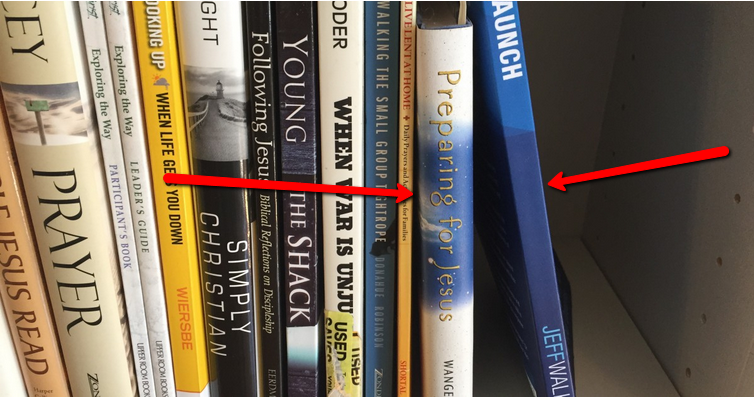
The other day I walked past my bookshelf, and this juxtaposition caught my eye—two books that have no business being next to each other. The one is an Advent devotional titled Preparing for Jesus: Meditations on the Coming of Christ, Advent, Christmas and the Kingdom by accomplished writer and National Book Award winner Walt Wangerin. The other is Launch: An Internet Millionaire’s Secret Formula to Sell Almost Anything Online, Build a Business You Love, and Live the Life of Your Dreams by self-made marketing expert Jeff Walker. I was struck not only with the seemingly contradictory messages of these books but with the fact that there they stood—on my bookshelf! They were in some way emblematic of the internal conflict I feel so often. Two Parts On the one hand I long to be near my Maker, resting and communing in the dance of Divine Love. On the other I desperately want the businesses in which I’m involved to succeed, and succeed fabulously, thank you very much. On the one hand I love the beautifully penned prose of a spiritual master. On the other I want to make a buck. Give me poetry, but then don’t wait too long before giving me tools. One impulse is all about living deeply and being spiritually attuned. The other is all about being successful in business and getting ahead and attaining the freedom that wealth affords. And I’ve noticed that my friendships seem to head in one trajectory or another too. Not exclusively, of course, but primarily I have friends who support my spiritual pursuits, and I have other friends who support my entrepreneurial pursuits. And I value both equally. For better or worse, this is just who I am. To deny one or the other part would be like hacking off limbs. In high school I was the drama geek who loved weight-lifting. Do you see what I’m getting at? Don’t Call It Contradiction So what am I to do with these apparently divergent parts of myself? What is any of us to do? I have worked with many, many authors who face a similar dichotomy. They want to write books of meaning and import, and they want people to read their books, yet they don’t want to be self-promoting. How should we think about such contradictions? Well, for one thing, I guess we should stop calling them contradictions. Does a spiritual impulse necessarily militate against an impulse to create and serve and make an income by doing so? [Tweet “Does a spiritual impulse necessarily militate against an impulse to create and serve and make an income by doing so?”] The other thing we must realize is there are different shades of motivation for either impulse. Wanting to commune with God is all good and fine and sounds super holy, but to what end? Is my doing so an act of love and gratitude, or is it an act of manipulation? Do I want to abide in God because of my love for God, or is it actually because I want God to run the world per my agenda? And do I read books like Launch merely because I want riches, or is it because I think I have something of real value to offer the world, and I want to be as strategic as possible about offering it? You see, as soon as we start thinking one part of ourselves is good and the other bad, we do violence not only to ourselves but to reality. We must continually check our motives, but let’s not be too quick to write off sides of the self. We are whole people, endlessly complex, entire universes unto ourselves. And the God who saw fit to breathe life into clay is not taken aback. Not in the least. We are free, friends. We are free to live out the different parts of who we are—always negotiating, yes, always careful, surely, but in confidence that it all needs redeeming anyway. And it so happens God knows something about redemption. He invented it. Go in peace, good pilgrims. [Tweet “Can We Be Both Spiritual and Successful? @ChadRAllen on reconciling our identities…”] [reminder]Do you struggle with your desire to be both spiritual and successful?[/reminder] Speaking of books, check out my free report: The Best Books Ever Written on Creativity, Writing, and Pursuing Your Dreams. Click the image below.
Where Most People Go Wrong When Chasing a Dream
Chasing a dream can be tough. It takes perseverance–sometimes more perseverance than we’ve ever had to muster in the past. Chasing a dream stretches us in ways we’ve never been stretched. I tend to think we actually become different people when we pursue a goal to which we feel deeply called. Watch this video to find out where most people go wrong on this journey and what I think the antidote is. What is “in the present” for you? What do you need to accomplish this week to move closer to your dream? Bonus Content: I’d love to give you my free Creativity Self-Assessment and Action Guide. A lot of people have found it helpful.