Quick Poll: Want to Hear from Authors, Editors, or Agents?
One of the great things about having worked in publishing for fifteen years is that I have a lot of friends in the industry. I’d like to use my access to some of these folks for your benefit by providing some interviews with them. It occurred to me that I could interview successful authors, veteran editors, or savvy agents. As I fretted about which group to pursue, I thought, why not ask you?! So, which group would you be most interested in hearing from? Authors, editors, or agents? Do you have a preference? Want to hear from all of them? I’d love your feedback in the comments or via email: chad@chadrallen.com Thanks!
The Key to Coming Up with a Bestselling Book Concept

Last week I asked, “Which book should I write?” and received a slew of great responses. Thank you! Interestingly, the book concept that rose to the top was that of how to come up with a book concept! The irony is not lost on me. I thought I would start by writing some posts on the subject. What is the key to writing a bestselling book concept? Meet a Need Bestselling book concepts address an actual need that other people have. The need could be practical, recreational, financial, relational, inspirational, emotional, spiritual, mental, physical, or behavioral. It could have to do with a person’s relationships, dreams, organization, or all the above. What’s important is that you identify a need your book will address. It’s also important to get really clear about the group or groups of people your book will help. Need vs. Heart Some might balk and say, “I don’t write need-driven books. I write from my heart, thank you very much!” And I understand the point. If our books are driven entirely by external factors like the needs people have, we run the risk of writing very shallow books and compromising our values in the process. We run the risk of writing the literary equivalent to candy instead of meat and potatoes. The trick, it seems to me, is in finding the intersection between where we are and where readers are. If all we do is “write from the heart” without regard to helping people, we run the risk of ending up with a journal, not a book. Recently I saw a store that sells olive oil. That’s it. Olive oil. Now I’ve been to Italy, and I know how passionate people can get about their olive oil. I appreciate high-quality extra virgin oil as much as anyone, but this store will not survive unless it reaches a lot of people who care intensely about olive oil. The owners may be passionate about procuring the very best olive oil, but if they can’t find customers, they won’t be in business for long. That’s just reality. The same is true for books. Look for the place where your passion meets the world’s need. Felt Need vs. Real Need Sometimes our felt needs, the needs that are immediate to us, are not our real needs. I may feel a need for a donut when what I really need is an apple! I may feel a need to better communicate when what I really need is to start preparing for my speeches much earlier than I do. I may feel a need for a million dollars when what I really need is to become content with less. As an author, you have an opportunity to meet readers where they are and then take them to a new place. Obviously you should not bait and switch or offer false promises. (Don’t tell me you can make me a millionaire unless you can.) But you can speak to what I’m feeling and then offer a solution I may not have expected. (You could offer a path to contentment, for example, that involves becoming free of an attachment to things.) Do you have an example of a book that spoke to a need you have but took you to a new place? Where does your passion meet the world’s need? What need do you want to address with your writing?
14 Benefits of Writing a Book Proposal Even If You’re Going to Self-Publish
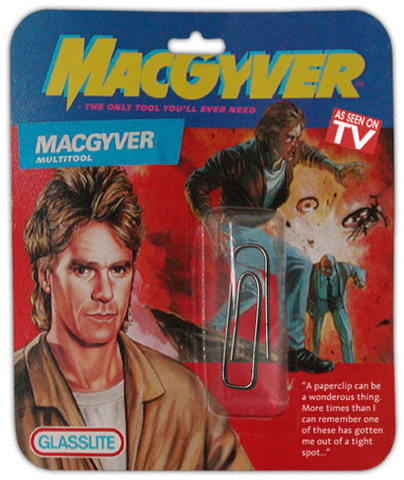
Macguyver was the all-time master of double use. Watch what he does with this paperclip, for example: I can’t promise writing a book proposal will save you from certain death, but doing so definitely has more uses than pitching an idea to traditional publishers. Writing a book proposal will help you: Clarify your vision for the book. Writing the brief description of a book proposal helps you to cast the vision—for yourself if no one else (but see 7 below). Define your audience. One of the most important steps to writing a book that has a market, not to mention marketing your book, is defining your audience. Structure the content. A chapter-by-chapter synopsis helps you see how your ideas will flow, one to another. Save yourself some work. The work you put into a book proposal now can save you a lot of work in the writing process later. Start working on a marketing plan. It’s never too soon to start working on a plan to promote. In fact, a little platform building while the manuscript takes shape can go a long way. Determine whether you have the energy to write the book. If you can’t finish the proposal, you might think twice about trying to write the book! Talk with others about what you’re writing. Writing a book proposal is a great way to get feedback from others and incorporate some really important tweaks before launching into the writing process. Try out various titles and subtitles. This is eminently worth doing. Figure out how long your chapters should be. Again, the chapter-by-chapter synopsis will help you figure out how many ideas to place within each chapter. Know what the next step is when the going gets tough. Writing has a way of taking us down rabbit trails. Your proposal will help come back to where you’re supposed to be. Focus. If the road map is front of you, it’s that much easier to stay on track. Establish your credibility. Working on your bio will help you explain to yourself, and others, why you’re a credible source for the information in your book. Try out different angles for the concept. This is somewhat related to number 8, but writing a proposal gives you an opportunity to try out different ways to position your book. Sometimes a subtle change can make the difference between a book that sells and one that doesn’t. Take the first big step toward actually writing a book! If you’re like me, you’ve been dreaming about writing a book for a while. Writing a book proposal helps you get that much closer. Are you working on a book proposal? What has been useful or frustrating about the process?
Book Proposal Coaching Update
For those who have been following along as Gary Neal Hansen and I work through a book proposal together, I wanted to give you an update. For those who don’t know what I’m talking about, here’s a brief setup: In December 2012 I started a series of posts on how to create a book proposal. I wrote two posts before realizing the series would be far more helpful to folks if I actually coached a writer through the process of crafting a book proposal. After a brief contest of sorts I decided to work with Gary Neal Hansen. My strong hope is that others will be working on their book proposals as I coach Gary through this process. So far I’ve posted about motivation, concept, bio, platform, working title, brief description, table of contents, chapter synopsis, and marketing section. Gary is working on the final piece, the writing sample. This will take some time, of course. But when he submits it I’ll do a post on this important element of any book proposal. And we’ll call the series a wrap at that point. Gary will also report on how his platform building is going and perhaps offer a few more closing thoughts for us. Stay tuned. I’ll keep posting at least twice a week. By the way, if you haven’t already be sure to check out the excellent discussion in the comments that followed Natasha Crain’s post: 8 Ways to Market Your Book on Facebook. Some great info there. Oh, and what would a coaching update be without a pep talk? Enjoy.
8 Essential Tips for Marketing Your Book on Facebook

Guest Blogger: Natasha Crain (www.christianmomthoughts.com) We all know Facebook is the largest social media network in the world. Our intuition tells us it can be a powerful tool for book marketing, but how do you use it effectively? In a word, it all starts with fans. The more fans you have, the more effective Facebook will be for you and your book. The best way to get more Facebook fans is to use Facebook effectively to build relationships with the ones you have. Facebook is a bit of a game. You have to understand the underlying rules to win, but the rules aren’t obvious. Here are 8 things you need to know. 1. If you’re serious about building a platform using Facebook, you need a Page. Personal profiles and Pages function very differently. A Page offers a one-way relationship between you and those who “like” your Page (your fans). Your fans see your updates, but you don’t see theirs. With a personal profile, a potential fan has to send you a friend request, which is an intimidating barrier for people who don’t actually know you. Even more importantly, personal profiles have a friend limit and only Pages give you data on how fans are interacting with your posts. That data is the key to your success – read on. 2. Any given Facebook post will only reach a small percent of your fans. Fans are people who clicked “like” on your page, so Facebook will make sure they see your updates, right? Unfortunately, no. Facebook has become so popular that it had to develop an algorithm to prioritize the flood of posts available for a person’s news feed each day. Say, for example, one of your fans is a fan of 100 other pages and has 400 personal friends. All of those pages and friends represent hundreds of possible messages going to that person’s news feed. Only a few of those messages will be shown. Your new fan may actually never hear from you again, depending on whether or not you understand number 3… 3. Likes, comments and shares mean almost everything on Facebook. Facebook chooses what to show and in what order based on which friends and/or pages a person engaged with in the past. “Engaged with” means the person clicked, liked, shared or commented on a post. If a fan doesn’t take one of those actions on your posts regularly, the algorithm will decide they aren’t really a fan, and that person will rarely, if ever, see your content again. You could have 10,000 fans but literally be talking to a near-empty room if Facebook is methodically removing your posts from their feeds due to lack of engagement. That means you should write every post in a way that facilitates likes, comments, or shares. 4. Small tactics can make a big difference in driving engagement. Here are some tips for encouraging those golden mouse clicks: Experiment with post timing. The average post is only shown in feeds for about 3 hours. If most of your fans are on Facebook in the evening but you always post in the morning, they’ll never see you. Be concise. Studies have shown that posts between 100 and 250 characters (less than 3 lines of text) receive about 60% more likes, comments, and shares than posts greater than 250 characters. Use different types of posts. Some fans click mostly on links, others engage mostly with questions, and some click mostly on photos. To maximize the number of fans who engage with you, use a variety of post types. Be careful about using third-party apps (e.g., HootSuite) to publish posts. Studies have shown that, for many reasons, these posts tend to get significantly less engagement. It’s best to post directly on Facebook 5. You can get around the “rules” by paying to promote individual posts. Under each of your Facebook Page posts you’ll notice button that says “Boost Post.” For a relatively small amount of money, you can get more of your fans to see specific posts. The cost depends on your particular fan base but typically runs around $5 per thousand people you want to reach. You can also promote your post so it will be seen by friends of your fans. Paid promotion is a great tool for getting important posts in front of as many people as possible. It’s also a great way to get back into the feeds of people you’ve lost due to lack of engagement in the past; if a person engages with a paid post, they’ll be more likely to see your future unpaid posts. Paid posts give you a chance to win fans back! 6. Fans are unequal in value. If you want to build relationships with potential readers of your book, your fans should be part of your book’s target audience. Asking your aunt’s friends and your spouse’s coworkers to “like” your page so you can build your fan number does nothing to build a true audience. Those people aren’t likely to engage with your Facebook content and the lack of engagement will negatively impact how many of your real fans see your posts. 7. You will lose fans (and that’s OK). It’s as easy for fans to click “unlike” on your page as it was for them to click “like” in the first place. It’s estimated that the average annual fan attrition rate for a Page is 5%. Fans who leave most likely weren’t engaging with your content, so it’s actually better for you that they go (see number 3)! 8. You shouldn’t depend solely on Facebook or any other social media site for your reader connections. If this all sounds complicated, you’re right! Companies now hire full-time social media experts just to maximize their opportunity to get into the news feeds of fans they already have. We tend to think of growing our fan count as a number-building problem, but the challenge extends to getting in front of fans once you have
How to Write the Marketing Section of Your Book Proposal

It’s an iconic line from an iconic movie. Maverick and Ice Man break the chill between them whilst maneuvering their F-14 fighter jets in a dogfight against a group of Russian MiGs. Each of them helps the other with life-saving aeronautical stunts. Back on the ground, mission accomplished, Ice Man expresses his newfound appreciation for Maverick. “You can be my wing man anytime.” “Bullshit,” Maverick responds, “You can be mine.” You’ll be glad to know publishers don’t expect you to save their lives, but the marketing section of your book proposal should assure them that you will be a good wing man, a good partner. It might surprise you how rare a good business partner is, which is exactly what you are if a traditional publisher contracts your book—not at the expense of being an artist but certainly in addition to that role. And bad partners can cost a publisher a lot of money. Brief setup: In December 2012 I started a series of posts on how to create a book proposal. I wrote two posts before realizing the series would be far more helpful to folks if I actually coached a writer through the process of crafting a book proposal. After a brief contest of sorts I decided to work with Gary Neal Hansen. My strong hope is that others will be working on their book proposals as I coach Gary through this process. So far I’ve posted about motivation, concept, bio, platform, working title, brief description, table of contents, and chapter synopsis. Following are the things I like to see in a marketing section: potential endorsers (well-known people with whom you’re acquainted who might be willing to lend a blurb), how often you speak and where, potential channels for marketing and promotional efforts, organizations with which you have a relationship that would be willing to help market the book, and sales history of previous works Gary’s marketing section, as I’ve come to expect from him, is straightforward and honest, and he has diligently included each item I’ve asked for above. This section is too long for me to include here (if you’d like a copy, hit Gary up via Twitter @garynealhansen, and I’m sure he would be happy to provide it). Instead, let me offer what just might be the killer app for writers who don’t yet have a big platform. Gary admits he is in this category, as are most writers. So if that’s you too, you’re in good company. Do this. Provide the items above as comprehensively and honestly as you can. Pull out all the stops, wrack your brain, and give us every bit of promotional potential you have at your disposal. Then turn the corner. Use a heading like “My Marketing Plan for This Book” or “How I’m Going to Help You, the Publisher, Move as Many Books as Possible” or “My Plan Moving Forward.” And then tell the publisher what you are going to do to build your platform and what you will do when the book releases. See, here’s the thing. Publishers recognize that if we sign your book today, the book isn’t likely to release for another 12 to 24 months. That’s a lot of time for an author to make a lot of headway in expanding his/her potential to bring exposure to his/her book. Michael Hyatt (@michaelhyatt) recommends writing down a sales goal. Define success. How many books do you want your book to sell in the first twelve months? Gary, if I were you, I’d shoot for 15,000. As with the working title, involve your friends. Brainstorm a plan for promoting your book. For example, Gary, you could talk about what you already have in place in terms of your blog and social media. You could even say you’d use whatever advance you receive to give a design facelift to your blog. Publishers love that kind of thing because it shows us you’re willing to put some skin in the game. This section isn’t about impressing a publisher with all you have going on as much as it is assuring the publisher you are going to be an awesome, go-getting partner. But you have to do more than just say that. What on a concrete level will you do? That’s what we want to know. And by the way, doing this will also help your book get into the hands of as many people as possible, which is the whole point, right? I mean, seriously, what’s the point of getting published if your book sinks without a ripple? Forget getting published. How are you going to help a publisher move X number of copies? Bonus Content: The best way to start a nonfiction book project is by writing a book proposal. I’d love to give you a free copy of my Book Proposal Guidelines, used by countless authors to write their book proposals.
How to Write a Chapter Synopsis for Your Book Proposal

It’s the oldest trick in the book for a cave tour guide. Ours, who halted us deep within Mark Twain Cave (near Hannibal, Missouri) shut off the lights and talked about how utterly dark it was. “To demonstrate,” he said, “try waving your hand in front of your face.” He was right, we couldn’t see a thing. Just then he turned on the lights, and we all looked rather silly waving our hands in front of our faces. In your chapter-by-chapter synopsis (aka chapter summaries), you are giving the reviewer a tour of your book. Your role here is to shed light on each chapter in a way that will keep the reviewer reading. But how do you do that? Brief setup: In December 2012 I started a series of posts on how to create a book proposal. I wrote two posts before realizing the series would be far more helpful to folks if I actually coached a writer through the process of crafting a book proposal. After a brief contest of sorts I decided to work with Gary Neal Hansen. My strong hope is that others will be working on their book proposals as I coach Gary through this process. So far I’ve posted about motivation, concept, bio, platform, working title, brief description, and table of contents. Let’s dive into Gary’s synopsis of his first chapter: 1. Community for Prayer — Benedictine Monasticism While Protestants often dismiss monasticism as running from community and service, for the medieval followers of Benedict of Nursia (c. 480 – c. 550) the opposite was the case. Entering monastic life was an intense immersion in community life where the purpose was to fit each member for heaven and much of the means was a shared life of prayer. Monasteries became the training centers for remarkable leaders who were then called to the world as the missionaries and bishops that brought Christianity to Europe–where they created new monasteries to train the next generation. The chapter will tell the stories of Benedictine monasticism and some of the notable leaders it produced. It will also draw out ways monastic life built community and discipleship through prayer, through its clearly defined roles, and through formal practices that encouraged humble service, mutual accountability, and individual growth. Not bad at all, I’d say. Gary gives us the gist of the chapter in relatively succinct form. I would encourage: Being even more succinct Referencing at least one narrative per chapter Including one sentence about the history of the group Including one sentence about the historical importance of the movement (i.e., what did it accomplish?), and Making at least one reference to what we can learn from the movement Generally speaking, a synopsis should: use the present tense (“This chapter explains…,” not “This chapter will explain…”) not be an exhaustive description (That’s what chapters are for!) entice the reviewer to keep reading (think: narrative references!) highlight the most marketable/saleable features of each chapter Following is my revision: 1. Community for Prayer — Benedictine Monasticism Opening with an engaging narrative about Benedict himself, this chapter counters the frequent Protestant error of equating monasticism with running from community and service. For the medieval followers of Benedict of Nursia (c. 480 – c. 550) the opposite was the case. Entering monastic life was an intense immersion in community life where the purpose was to fit each member for heaven largely through a shared life of prayer. Monasteries became training centers for remarkable leaders who then went into the world as missionaries and bishops. They did nothing less than bring Christianity to Europe, and we have much to learn from them about prayer and discipleship. [callout]Bonus Content: Even more important than your synopsis are the chapter titles and subtitles you include in your book proposal. For a brief video training on how to develop compelling titles and subtitles, including a sample Table of Contents makeover, click here.[/callout] [Tweet “How to write a chapter synopsis for your book proposal #amwriting via @ChadRAllen”] Are you working on a chapter synopsis? Drop it in a comment, and I’ll do my best to help.
How to Describe Your Book to a Publisher

Down through the dusty annals of antiquity comes the whisper of wisdom to any writer bold enough to listen: “Without vision, the people perish.” Or, as I like to say, “Without vision, publishers will run for the hills.” You’ve come up with a concept, crafted a bio, and developed a working title and subtitle. Now it’s time to go deeper with a brief description of your book. The brief description is where you cast the vision for your book. The working title begins to do this, and hopefully it’s compelling enough for an editor to turn the page. Once she does, what vision will she see? If it’s compelling, you’ve got a solid chance of getting published. If not, well, not. Brief setup: In December 2012 I started a series of posts on how to write a book proposal. I got two posts in before realizing the series would be far more helpful to folks if I actually coached a writer through the process of crafting a book proposal. After a brief contest of sorts I decided to work with Gary Neal Hansen. My strong hope is that others will be working on their book proposals as I coach Gary through this process. So far I’ve posted about motivation, concept, bio, platform, and working title. You may want to include a one-sentence summary before the brief description, and agent Rachelle Gardner did a fine post on this. The brief description is a three- to five-paragraph summary of your book as a whole, including: its purpose, targeted readership, anticipated length, and an ETA for the complete manuscript Obviously you could simply write these like a robot . . . Purpose: to change the world Targeted readership: people Anticipated length: 50,000 words ETA: In six months You might chuckle at this, but I promise I have seen proposals that are just this . . . uninspired. Reading is nothing if not an experience. Your brief description is casting a vision for the kind of experience readers will have when they read your book. This is also likely the first place an editor will be exposed to your writing style. In other words, the brief description is your first writing sample. See why it’s important? Following is Gary Neal’s brief description: One for the World: How Christian Community Has Been (and Can Be) a Catalyst for Mission looks at six historic movements, each of which had a distinctive way of living in Christian community. In every case their community life blossomed into service and mission that changed the world. In every case there are priorities, practices, and other elements for today’s churches and fellowships to make use of to deepen relationship with God and neighbor, and to empower participation in God’s work. The movements span 1500 years and have a broad ecumenical range: Benedictine monasticism, the Beguines of the Middle Ages, Reformation-era Reformed Protestants, the Moravian Pietists of Herrnhut, the early Methodists under John Wesley, and the more recent Christian Base Communities of Latin America. Their own lives were changed by the ways they drew close to God and to each other. In the process they developed compassion for God’s beloved world and the skills to reach out to it. The theological taproot of the book is Jesus’ prayer in John 17. Jesus prays that the church would be as united as Christ and his heavenly Father–an extraordinary standard for Christian community, since Jesus describes himself and his Father as virtually one through a kind of mutual indwelling. And he prays that his followers, by virtue of being one, would serve his purposes in reaching the world with the Gospel–which is radically countercultural in a day when community is often measured by the private feelings of the community’s own members. Each of the six chapters of the 53,000 word book tells the story of one group and its impact, examining the practices and norms that created its unique ethos and quality of life. The conclusion looks briefly at six movements from our day that in very different ways seek to create community for depth of discipleship and to catalyze mission. An appendix provides guidance to pastors and small group leaders who want to lead study groups on the book. The aim is to explore history for the sake of finding wisdom for the present, so each chapter also includes tools for individuals and groups to use as they evaluate their present community life and dream a more faithful and more satisfying, more effective future. Rather than encouraging people to reproduce one of the historical movements studied, the book helps readers see their own communities clearly by comparing and contrasting priorities, practices, structures and norms with effective communities from the past. The goal is to develop ways of being community adapted to the 21st century context that deepen a shared life of discipleship. The target audience is those who want tools to create community life more meaningful than what is offered in their churches; more meaningful because it prompts deeper engagement with God, richer relationships between members, and an engagement with the world that grows from their living of the Gospel life. This includes those in traditional congregations who long for something more in their life together, college students thinking through adult discipleship in the context of para-church fellowships, and those currently developing new communities of faith such as emergent church plants and the New Monasticism. The book has potential in the textbook market as well; I am developing a class which would use this book as its framework, fleshed out with primary sources and other current works. I am eligible for a year of sabbatical leave, during which I will do the bulk of the writing. However, it is not institutionally convenient for me to take the sabbatical until the 2014-2015 academic year. Therefore the projected date for a completed manuscript is September of 2015. This is a solid description, no question, and Gary certainly covered all the points a brief description needs to cover. He also exhibits
How to Come Up with a Working Title for Your Nonfiction Book Proposal

When my wife and I started dating, we were caught in the magnetic chemistry of young love. It was roses and smiles and sighs and bliss. Then I messed up. I asked her out to a restaurant where I had a coupon from a previous girlfriend. That was bad enough, but it got worse when she asked me why I had picked the restaurant, and I told her about this coupon from my ex! It was just bad on so many levels. She was a good sport about it, but I still called her later in the day to smooth things over. I remember being really vulnerable at one point and saying, “I just don’t want to mess this up.” The job of your working title is to avoid messing things up for the rest of your proposal, and its importance is hard to overstate. Working titles encapsulate a concept. They either draw us in, or push us away. Brief setup: In December 2012 I started a series of posts on how to write a book proposal. I got two posts in before realizing the series would be far more helpful to folks if I actually coached a writer through the process of crafting a book proposal. After a brief contest of sorts I decided to work with Gary Neal Hansen. My strong hope is that others will be working on their book proposals as I coach Gary through this process. So far I’ve posted about motivation, concept, bio, and platform. The goal is for your working title to keep the doors swinging open, to intrigue the publishing folk enough that they turn the page and keep reading. So how do you come up with a great working title? Assume that when a person sees your working title, they don’t know you from Adam and certainly don’t know a thing about your book idea. Ask: What need is this book meeting? What is the need other people have that my book will meet? It might be a good idea to journal about this or even blog about it to get input from others. The need you think people have may be different from the need they actually have. Ask: What are the truly essential pieces of my book? Now brainstorm some titles and subtitles. Then go to your community or social network and brainstorm again. You can do this via social networks, but you can also invite people over for pizza or drinks and brainstorm that way. Do this more than once. Pick the best title that comes from this process for your proposal, but include a list of other titling directions too, both titles and subtitles. Among other reasons, this shows the publisher you’re flexible and not married to any particular title. The title Gary sent in originally was: One for the World: Six Ways of Being Christian Community that Have Changed the World — and Can Do It Again I liked the sub and in part picked him to work with because of it, but he received some comments from folks that it was grammatically confused. He noted this as he went into brainstorming mode. His brainstorming included his own work before applying for this coaching process, two rounds with friends on Facebook (separated by several days, with somewhat different descriptions of the book), one blog post requesting feedback, and one similar request on Twitter. He writes: “My own brainstorming took me most directly to my own intended meaning and purpose, not surprisingly. Facebook garnered the greatest numbers, with some joking around, many going in directions that are different than the book, and a few that add something to work with.” This is important. Brainstorming is mysterious. Sometimes it’s full of great ideas and electricity that seems to bounce off one person to another. Other times it falls flat, and you don’t get very far. In the latter case, it’s probably best to simply drop it and try again some other time. Ten titles emerging from the brainstom: One for the World The Community Book Community Matters Community for Mission Walking Together, Working Together Taken, Blessed, Broken, Given Body Building Deep Roots, Wide Branches Twelve Baskets Full Inside Out Five Subtitle Options Six Approaches to Christian Community that Changed the World How Gathering as Christian Community Catalyzes Mission Christian Community that Matters for the World What Real Christian Community is Good For Historic Understandings of Christian Community Gary’s current favorite: One for the World: Christian Community that Catalyzes Mission At this point I’m just one editor reflecting on Gary’s titles. If you ask ten editors to respond to it, you’re likely to get at least twenty opinions, so keep that in my mind. My concern about the title (we’ll get to the sub) is that with the word “One” it seems to emphasize the individual. However, I like the current title’s emphasis on being “for the world.” This is a book about mission. In terms of the title’s intrigue factor, it does carry some intrigue, but I would hope for more. And here’s some of my brainstorming: In the Name of Love Poured Out For the World 6 Ways Christian Community Has Changed the World 6 Communities That Changed the World 6 Ways to Change the World I’ll note here that six doesn’t sound like enough. I would want at least ten in the final book. Now for the subtitle. Gary’s current fave is “Christian Community that Catalyzes Mission,” but he wrote, “A significant weakness, to my eyes, is that this does not communicate the focus of the book on historical movements–which is the nature of the project, as well as the connection of the book to my ‘brand.’ The flip side of this is that a title which says that a book focuses on history may not sing in the marketplace.” Actually I think historical movements that have changed the world are really inspiring. And I like word “movement.” Who doesn’t want to be part of a movement that makes a lasting
How to Write a Compelling Bio for Your Book Proposal
Growing up, my family had a running joke. Whenever someone asked for a tissue, invariably the response came back: “Tissue? I don’t even know you!” Publishers invest a lot more than a tissue’s worth in the books they publish, so it’s important for them to know who they’re working with. That is why your bio may well be the first thing an acquisitions editor reads in your book proposal. It is certainly the first thing I read. A good bio can either open the door to the rest of your proposal or stop the review process almost as quickly as it began. Brief setup: In December 2012 I started a series of posts on how to write a book proposal. I got two posts in before realizing the series would be far more helpful to folks if I actually coached a writer through the process of crafting a book proposal. After a brief contest of sorts I decided to work with Gary Neal Hansen. My strong hope is that others will be working on their book proposals as I coach Gary through this process. To read the posts leading up to this one, see here, here, here, and here. Following is the bio Gary sent: Gary Neal Hansen is Associate Professor of Church History at the University of Dubuque Theological Seminary and the author of Kneeling with Giants: Learning to Pray with History’s Best Teachers (InterVarsity Press, 2012). The book has received a broad ecumenical welcome, including an interview in Christianity Today, a “Best this Month” feature in The Lutheran, and an interview on the Catholic Channel of Sirius XM Satellite Radio. He is passionate about mining the wisdom of Christian history to help today’s Christians know and love God, grow in community, and serve Christ’s purposes in God’s beloved world. His sense of Christian community was shaped by undergraduate years at University Presbyterian Church in Seattle (where his pastor, Steve Hayner, once referred to him as a small group guru). Years as a small church pastor and study leave in a Benedictine monastery highlighted the range of understandings of Christian community. His scholarly writing is found in volumes published by Cambridge University Press, T&T Clark, Mohr Seebeck, Eerdmans and others, with writing for a general readership in The Presbyterian Outlook, Presbyterians Today, and Theology Matters. He speaks regularly at conferences and retreats–typically two or three times per year, and thus far in about a dozen states. He is currently developing a slow-motion book tour with leftover funds from a Louisville Institute research grant. Weekends find him with his wife and two small children looking for whatever is fresh and local at the farmers’ market, or cooking it up for friends. Let the coaching begin. Good work, Gary! This bio has a lot going for it, though I do see some possible ways it can be improved as well. Your bio is essentially your opportunity to tell the publisher who you are, but obviously we’re not interested in your favorite pizza toppings or what size shoe you wear. Anytime you make your bio available, whether to a conference or on your personal blog or a company or institution website, it should be tailored to the audience reading it. That is why your book proposal bio may well be the only place you use this particular version of your bio, though certainly it can be drawn upon for other venues as well. Your book proposal bio should: Be no more than 250 words. Shorter is okay! Establish your credibility. What’s your main vocational role? How are you qualified to write about the topic of your book? What work have you already done on the topic? Give us a glimpse of your platform. How can you help the publisher promote your book? What are your networks? How much are you speaking? Give us a sense of you as a person. Will you be reliable and fun to work with? Notice that Gary’s bio does all of these things—in part because he read my previous post on this topic. I love that he says right at the top what his main vocational role is. I can’t tell you how often we have to hunt for this information—sometimes to no avail! He establishes his credibility as an author with a reference to his first book and how it’s been received. He tells us what he’s passionate about, and he gives me a sense of what kind of guy he is in the last sentence. Great stuff! I do, however, see two places where the bio can be improved. The first is here: His sense of Christian community was shaped by undergraduate years at University Presbyterian Church in Seattle (where his pastor, Steve Hayner, once referred to him as a small group guru). Years as a small church pastor and study leave in a Benedictine monastery highlighted the range of understandings of Christian community. The impulse is right here. Gary is trying to show that he’s more than just book smart on this topic. He has real-world experience to offer. The problem is these sentences make me feel like his experience is relatively limited. He learned about community at school, in a church, and for a week at a monastery once. It’s probably better to frame this section in terms of the places where Gary has worked out his ideas about community. That way he’s not implying a limited basis of practical knowledge. He’s just talking about the places where he’s worked out a bunch of ideas. Even better, however, would be some reference to the fruit of the ideas he will be sharing in the book. “Gary,” for example, “has seen the power and redemptive influence of Christian community play out in his church and small group as he and his friends have done transformative work both locally and globally.” And obviously the more concrete he can be here, the better. The other section that can be improved is here: He speaks regularly at conferences and retreats–typically two or three