How Writers Can Use Speaking to Build a Platform and Sell Books

Grant Baldwin is the founder of The Speaker Lab, a training company that helps public speakers learn how to find and book speaking gigs. Through his popular podcast The Speaker Lab and flagship coaching program Booked and Paid to Speak, he has coached and worked with thousands of speakers. His book, The Successful Speaker: Five Steps for Five Steps for Booking Gigs, Getting Paid, and Building Your Platform just released, and it’s a gold mine if you want to use speaking gigs to build your platform and sell books. In this interview we cover: How Grant went from being a youth pastor to a successful public speaker to a trainer and coach for other professional speakers The biggest mistake aspiring speakers make How successful speakers rapidly grow their businesses and platforms How to book more speaking gigs How writers can use speaking to land book deals and sell more books How speaking can help you improve your writing The biggest differences between speaking and writing What you’ll find in Grant’s book, The Successful Speaker, that you won’t find anywhere else And much more! Enjoy! To order your copy of The Successful Speaker, click here. To connect with Grant and hear about his programs for speakers, click here. [Tweet “Have you ever thought about becoming a professional speaker? Check out this info-packed interview with @GrantBaldwin @chadrallen #amwriting #speaker #thespeakerlab”] What was the most helpful thing you heard in this interview?
Want a Book Deal? Download My New Book Proposal Template!

For a lot of people book proposals are intimidating and scary. I wonder how many books don’t happen just because the prospect of a book proposal is so daunting. Often writers don’t know what goes into a book proposal. What are the different pieces? How long should each section be? How should I organize the different elements? Are some elements more important than others so those should come earlier in the proposal? Is there a generally accepted way the different pieces should be formatted? What are the headings I should use throughout my book proposal? And so on. I can’t write your book proposal for you, but I can address most of these questions with my new Book Proposal Template! Numerous writers have asked me for this. In the past I’ve had general guidelines, but this is definitely an upgrade. The beauty of a template is it gives you a path to follow. You can simply “fill in the blanks,” as it were, and begin crafting your book proposal. I hope you find it useful. ENJOY! Click here to download my just-released book proposal template. [Tweet “Need help with your book proposal? Check out this Book Proposal Template from 20-yr publishing insider @ChadRAllen”]
The Fun, Fabulous Way to Build a Platform

Recently I went ice skating with my kids. This is an activity we do once or twice or year, so none of us is all that proficient at it. My seven-year-old daughter, in particular, is still learning the basics. A little wobbly. During our most recent outing I placed myself a few feet in front of her, then encouraged her to skate to my outstretched hands. She shuffled her feet and grabbed my hands, we celebrated, and then I moved out another few feet. After doing this several times, I began to move a little further out—five feet, maybe. And again she’d shuffle her feet, intuitively picking up the movements that made a difference. I was so proud of her. She was boldly moving her feet and making steady progress. At one point, though, I looked at her face and noticed she was concentrating really hard—almost too hard. I mean, we were ice skating, not performing brain surgery! “Hey,” I said, looking her in the eyes, “remember to enjoy it a bit.” She immediately relaxed and kept doing her thing. Enjoy It a Bit Anytime we’re learning something new, whether ice skating or audience building, it’s hard work, especially in the beginning. When you’re just starting, you don’t know anything about anything, so you just start trying stuff. You shuffle your feet. Quickly we can end up getting discouraged or worn out or just simply paralyzed. That’s why it’s important to have some fun along the way. If you’re building an audience, remember that every action you take is in one way or another moving you forward. Even if you do something that seems to shrink your audience, you’re still moving forward because you’re learning. Sometimes you have to do the wrong things to know how different they feel from the right things. And sometimes shrinking your audience is exactly what you need to do to make sure you have the right audience. So relax. Have some fun. Serious Business You might be tempted to think, “Wait a second! Who has time for fun?! I have to get stuff done, man!” OK, I respect that, but tell me honestly, do you really think you’re going to get further ahead by screwing up your face and push, push, pushing, working 10-hour days, neglecting your health and family, and so on. I don’t think so. Let me be clear. I’m not telling you to be lazy. And I’m certainly not telling you to give up. I’m telling you to enjoy the journey. If you don’t, you’re likely to burn out and either give up or be angry—neither of which (as long as we’re being honest) is your best look. My Own Experience I’ve been platform (audience) building for over six years now, and sometimes the pace of progress is maddening. Even after all this time with hundreds of people who regularly read my content, I get frustrated that things aren’t moving more quickly. Every now and again I have to catch myself and just smile, knowing that this is my art, my life’s work. What would I rather be doing than this? Nothing. I can’t imagine a better investment of time and energy than serving the people I’m passionate to serve. A Few Pointers So how do we do this? How do we infuse the process with more levity so that we can make steady progress, avoid burnout, and have some fun along the way? Following are some pointers that may be helpful to you. Recognize this is going to take some time. Rome wasn’t built in a day, and neither are personal brand platforms like the ones you and I are building. Get a guide and a supportive community. Hopefully you have someone helping you, someone who has a little more experience to whose hands you can skate. A good guide can shorten your learning curve significantly and help you avoid painful mistakes. If you’re a writer who wants to get published, consider BookCamp, my mentoring and training hub for writers. Click here to learn more. Start shuffling. Go a few feet, then go a few more. What if my daughter kept comparing her ice skating to that of Olympian Michelle Kwan? She’d be endlessly discouraged. Yet that’s what we tend to do with our platforms. It’s good to have goals and a strategy, but once you have these, focus on showing up. Showing up and going a few feet. That’s the win. Having a platform isn’t the thing. Building a platform is the thing. I used to think having a platform was the goal, but now I know all the good stuff happens when you’re building a platform. When you’re doing the work of building a platform, you are engaging with people, learning about them. My first product (Book Proposal Academy), for example, was the direct result of listening to the needs of one of the writers I was serving. OK. You’re ready, brave writer. Whether you’ve been platform building for a while or you’re just getting started, you can do this. Show up and go a few feet. And hey, remember to enjoy it a bit. [Tweet ““Showing up and going a few feet. That’s the win.” Platform advice @ChadRAllen #amwriting”] What does “showing up and going a few feet” look like for you right now?
What Every Author Needs to Know about Publishing and Marketing on Amazon
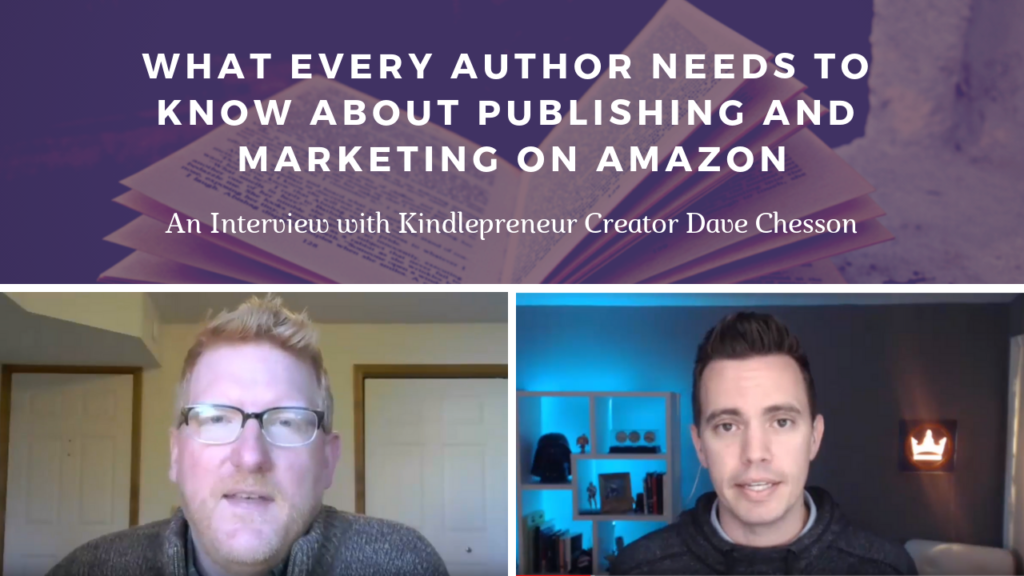
We all know Amazon is the biggest bookseller in the world by far, but marketing on Amazon is still a mystery to many authors. Most writers don’t understand what makes a book an Amazon bestseller. And they’re confused about how to work with the Amazon platform to market their books and increase sales. That’s why I interviewed Dave Chesson, the guy Amazon tells people to listen to, about all things Amazon. This is a powerful interview that will help you master Amazon and maximize the power of the world’s largest retailer. Enjoy… [Tweet “What Every #Author Needs to Know about Publishing and Marketing on #Amazon”] [callout] Would you like a transcript of this interview? Click here to download your free copy.[/callout] What was most helpful to you in this interview?
What Is a Writer Platform and How Do You Build One?

Below are questions I received recently about how to build a writer platform followed by my responses. My hope is that these questions are broadly representative of those many writers have about this often vexing topic. Before I jump into the questions, let me first define what I mean by platform. An author’s platform is essentially any means an author has for promoting her book. These days one of the key metrics for a platform is email subscribers. This is because email is one of the most effective ways to market anything right now. Marketing expert Neil Patel said, “Email remains one of the most effective channels of marketing, with a median ROI that’s nearly 5x that of other channels like social media, direct mail, and paid search.” With that as background, here we go! First question . . . Q: “My biggest roadblock, honestly my greatest frustration, is platform. I understand what it is and why it’s so important for nonfiction writers, but what escapes me is exactly how large one’s platform has to be to get a traditional book deal with a major publisher. I have seen some articles that say 10,000 email subscribers, still others say 100,000! Those numbers are vastly different. Which one is most accurate?!” Having a platform is important to landing a book deal. In fact, in my experience too small a platform is the number one reason publishers turn books down. The rule of thumb I offer to writers is to have at least a thousand email subscribers before you start submitting your book proposal. Having a thousand subscribers takes work, but I believe just about anyone can do it—with some hustle and time. The ultimate measure of the effectiveness of your platform is this: If a publisher sent a thousand or five thousand (or whatever number of) copies of your book to your garage or basement, could you move them? At this point you might be tempted to balk. Isn’t it your job to write the book and the publisher’s job to promote it? In a word, no, not when it comes to trade publishing. Publishers have always relied on authors’ ability to promote their work. One result of this is that you as an author are in competition with authors who are quite willing to do that promotional, platform-building work. If you were a publisher and you were deciding where to invest your capital, would you pick an author who had the ability and desire to help you promote or the author who thought promotion is entirely the domain of the publisher? So aim for a thousand subscribers to start. Then keep serving your audience, collaborate with people in your niche who already have an audience, do giveaways, write great guest posts for other bloggers. The list of ways to build your list is endless. [Tweet “”Too small a platform is the number one reason publishers turn books down.” #Platform tips #amwriting @ChadRAllen”] Q: “What’s the best way to establish a platform and build an audience if you’re still working on the manuscript?” The best way to establish a platform and build an audience is to begin serving the audience you envision for your book. You can do this in many different ways. For example, you can repurpose snippets of your manuscript in content that you publish via your blog, vlog, or podcast. You don’t want to get too carried away with this, but a bit here and there is no problem. You can also build your platform by inviting people to go on the journey with you. Let them know you’re writing a book. Let readers know you want to make the book as engaging or as helpful as possible, and would they go on the journey with you? They’re out there, I promise. Your tribe is waiting for you to call them together. [callout]BookCamp members Evelyn Sherwood, Deb Hucke, and Doris Swift are rapidly building their audiences. Using the trainings inside BookCamp, they went from zero to hundreds of email subscribers in less than a month. I invite you to visit www.BookCamp.us to learn more and register! We’d love to help you get your book into the world.[/callout] You’re not at a disadvantage to be working on your platform prior to completing your manuscript. In fact, if you can get feedback on your blog content, your manuscript will likely benefit. As you publish posts, you’re going to learn about what resonates with your readers. You’ll naturally shape your manuscript accordingly. [Tweet “What Is a Writer Platform and How Do You Build One? #amwriting #askeditor @ChadRAllen”] Q: “What kind of content should be in a blog or website to build an audience for a work in progress?” In short, blog for the audience you envision for your book. What questions do they have? What problems can you help them solve? What interests them? What do they like to geek out about? Use your blog to serve them. If you keep using your blog or website to solve problems for your audience, they will respond when you have a book to offer because they will trust you. Q: “Can I work with a publisher if I haven’t previously written a book and have no sales records to show?” Yes! In fact, it is generally easier to land a book deal as a first-time author than it is to do so if you’ve written a book that has not sold very well. In most cases you don’t need a sales record to land a book deal. Publishers make publishing decisions based on three primary factors: how compelling a concept is, how effective a platform is, and how engaging the writing is (aka the three C’s: Concept, Crowd, and Craft). If you can demonstrate you have those three things, you have a really good shot at a book deal. What questions do you have about building a writer platform?
This Is How I Really Feel about Platform

Can I be honest with you? I get tired of talking about platform, and I’m sure writers get sick of hearing people like me talk about platform. Why is this? I think it’s because the work writers do to build an audience often feels other than and separate from doing art. The Difference between Art and Platform After all, when I do something that really moves the needle for my own platform (scheduling a partner webinar, creating a lead magnet, reaching out individually to people who might be interested in my work), I’m not usually engaged in artful writing. Having said that, we must never overlook the gradual audience-building power of consistently producing the best content we can. I just started reading the wonderful book Atomic Habits by James Clear, and in the beginning of the book he recounts the rapid growth of his audience. Clear started a habit of publishing a new blog post every Monday and Thursday. His email list grew to hundreds of thousands in a couple years. His case is exceptional, but it points to the effectiveness of consistency. Certainly, his story and others like it make me believe consistency is worth a try. Could it be everything rises or falls on whether or not we are consistent? Joseph Michael, recently profiled in Entrepreneur magazine, hardly blogged at all, yet he has a large platform too. His consistency came in a different form: he scheduled a lot (I don’t know how many, but it was a lot by any measure) of partner webinars over a period of years. Platforms can be built in a variety of ways. The trick is finding what works for us and doing more of it. [Tweet “”Could it be everything rises or falls on whether or not we are consistent?” #platform thoughts via @ChadRAllen”] Where Art and Platform Come Together I also think it’s important to question how separate doing art is from building a platform. I don’t mean inviting people to our email list is the same as creative writing. What I do mean is when we invite someone to our email list, we are asking for the opportunity to serve that person with our art. Is a writer doing art at her book signing? Not in the strictest sense, but she is doing work that supports her art, and so the two are not opposed to each other. They are allies. Your platform is not your art, but it is an ally to your art. [Tweet ““Your platform is not your art, but it is an ally to your art.” #amwriting #askeditor @ChadRAllen”] Do you struggle with building your platform?
How to Get Your Audience to Tell You What to Write

I often hear from writers who have a vague idea of their message and who they want to serve, but they struggle to nail it all down. They don’t have clarity about how to position themselves, what to write about, and who exactly is their audience. “I seem to be good at [fill in the blank],” they say, “but I don’t know where to go from here.” If you find yourself in this situation, it can be frustrating and even scary. You end up asking yourself questions like: What should I write about? Who are my readers? How should I go about this? Will this ever get off the ground!? These questions can cut you off at the knees. In today’s blog post I share four steps that will help take the load off and get your audience to tell you what to write. Step 1: Write and publish a lot If you’re a little fuzzy about what to write or who to write it for, the best thing you can do is start writing. Clarity comes with action. In the beginning resist the temptation to measure traffic, shares, subscribers, and so on. Measure your own hustle. Are you getting your writing in? Are you producing content? Are you hitting “publish” regularly and letting the world know that you have something new to share? Hang out in “write and publish” land for a while. Make it your goal to get thirty blog posts published before you do much at all in the way of assessment. One more thing: Work hard to serve somebody with what you write. Do your best work. Step 2: Notice how people are responding. After you’ve written thirty blog posts, go back now and pay attention: Which blog posts did people notice? Which ones were shared? Which ones received comments? Jot down some observations. If you are not getting much interest at all, go back to step 1 and write another thirty blog posts. Step 3: Identify what’s reproducible and what isn’t. When you have a sense of what’s working for your audience, think through questions such as: What patterns do I see? What sort of content do people seem to enjoy and find helpful? What seems to resonate that I can do over and over again? What is not reproducible? It’s true that some things cannot be repeated. If you share a story about winning the lottery and you get a bunch of traffic, chances are you won’t be able to tell another story about winning another lottery. But be careful here. Often we assume something is not reproducible when really it is. It might be hard work, it might take some additional creativity, but try not to sell you or your audience short. Once you have clarity about what your audience wants, hold onto it. For example, one of my best-performing posts was an interview I did with literary agent Christopher Ferebee. I might be tempted to think, “Oh, I can’t reproduce that! There’s only one Christopher Ferebee!” But that would be giving up too easy. The natural question is, Who else do I have access to that my audience would find helpful? And of course the possibilities are endless, which is why I have done a number of interviews since then. [Tweet “”How to Get Your Audience to Tell You What to Write” via @ChadRAllen”] Step 4: Keep writing, keep noticing, tweak as necessary. Frederick Buechner said, “The place God calls you to is the place where your deep gladness and the world’s deep hunger meet.” That’s what we’re after. We want to write out of a sense of calling, of deep gladness, and then notice where our audience is hungry. That’s our sweet spot. That’s clarity. One of the great joys of writing in our day and age is it takes very little time to find out how the world will respond to something we’ve written. I think of it like a dance. We take a step and then it’s our audience’s turn. We go back and forth like that until we get a feel for each other, and then we keep innovating. It is a process that is at times maddening and at other times absolutely euphoric. And the whole project is an almost unimaginable privilege. What about you? What are you interested in writing about? Who’s your audience? What are you noticing in how your audience responds to your work?
How the Right Mindset Leads Writers to Success

Recently we had to send out the dreaded “OP” letter again. It goes something like this: Dear Author and Agent: We are writing to inform you that due to low marketplace demand for your book, we have decided to discontinue keeping it in stock. Sincerely, The Publisher “OP,” in other words, stands for “out of print,” and publishers send it to authors and their agents when demand for a book falls so low, the publisher can no longer justify keeping the book in their warehouse. The ideal, of course, is for a book to stay in print forever. The first book Baker Publishing Group (the company I serve as an editorial director) ever published over seventy-five years ago, More Than Conquerors by William Hendriksen, is still in print. And if a book stays in print for twenty or thirty or fifty years, that’s nothing to sneeze at. The cases that grieve me are when physical books go OP after just twelve months. These days publishers often keep the ebook version in print because it costs very little to do so, but in an OP situation the physical copies become unavailable. And it’s a sad day in the life of a book. Here’s the thing I don’t want you to miss about authors whose books go OP that quickly: About two years prior they received what so many writers pine for—the Holy Grail of ambitious writers the world over, the great and mighty, the glorious book contract! Unfortunately, if an author’s book goes OP in twelve months or less, it will be really hard for that author to get another book deal. So it’s just bad for everybody, particularly the author. In fact, one could argue that in a case like this a book contract is more of a curse than a blessing. The Right Mindset How can we writers stay out of this predicament? Great question, and the answer has everything to do with how you define success. If you define success by whether or not you win a book contract, you are headed in the wrong direction. Now don’t get me wrong. Book contracts can be an important means to an end, but they are not the goal. They are functional; they are a tool, nothing more. [Tweet “”Book contracts can be an important means to an end, but they are not the goal…””] The right definition for success is to write a compelling book that goes out to thousands of readers. I know one author who defines success by selling 100,000 copies of a book in the first twelve months. That’s too high a bar for most authors, but my point is this author is aiming in the right direction. So how do you make sure you write a great book that sells thousands of copies? You write a great book that sells thousands of copies by doing the day-in, day-out work of craft and generosity. You write a lot, and you share a lot. You keep writing until you become a good writer, which just about everyone can become. And you share what you’ve written—over and over again. You love on your tribe. You serve readers. You help them with the real needs they really have, which might mean addressing a felt need first so that eventually you can address a deeper one. Finally, you decide that you’re in this for the long haul. If you make up your mind to stick with it no matter how long it takes, you’re all but guaranteed to succeed. The Really Good News So that’s it. No magic formula. No silver bullet. The recipe for success is deciding to show up day after day to become a better writer and to serve people. The really good news here is you have a lot of agency in whether or not you succeed. You don’t get to decide whether a publisher picks up your book; that’s not up to you. You do get to decide whether you show up and do the work. And as long as you keep taking up that challenge, you really can’t lose. And consider this: How would you rather spend your time? Fact is, if you’d be happier doing something else, cut your losses and go for it. Most writers I know wouldn’t be happy doing anything else. The human heart was made to do the work of its calling, and if you’re a writer, your calling is to write and serve people with your writing. It is a sacred vocation, worthy of your best efforts. Do your best to enjoy the journey. [callout]Would you like to design a writing process that aligns with who you are and your season of life? I created a PDF worksheet called ‘My Writing Process’ that will help you do just that. Click here to download the *My Writing Process* worksheet. [/callout] What did you find most helpful in this blog post?
How to Write Your Book and Blog at the Same Time

Think of a drummer in a rock band. Somehow she manages to keep that bass drum going while rat-a-tat-tatting on all the snares and cymbals above. That’s what we want to do with our blogs and books. We want to keep our blogs dynamic and lively, releasing new posts regularly, while at the same time making solid progress on our book manuscripts. Why? Because our blogs help us build a readership, while our books help us go deeper into the content we want to share with the world. If we stop (or never start) blogging, it’s quite possible we won’t have an audience for our books. That’s no good, so how do we do both? Writing a great book while maintaining your blog’s momentum can be difficult, but the reward is worth the effort. You can succeed at both. Here’s how. Strategy #1: Commit to the Long Haul Writing a book and building an audience via your blog takes time. If all you want is a book with your name on it, go ahead: drop the blog and just write and self-publish your book. But if you want to write a book that a lot of people read, and I hope you do, commit to sticking to this for the long haul. Strategy #2: Give Space to Both It’s important to give space in your life and calendar to both the book and the blog. The two perform different functions, and each deserves your careful attention. You can do this a lot of different ways. Weekdays for one and weekends for the other Mornings for one and evenings for the other Monday, Wednesday, and Friday for one, Tuesday and Thursday for the other The first two weeks of a month for one, the last two weeks for the other Decide on an approach that gives space to each, and don’t be afraid to switch things up as you go. [Tweet “Want to write a book and blog at the same time? 7 tips from @ChadRAllen #amwriting #askeditor”] Strategy #3: Set a Manuscript Goal and a Blog Goal As you begin this journey, I recommend setting a goal for when you’ll complete the first draft of your manuscript and a goal for how many email subscribers your blog will have by when. For simplicity it might be useful to set the same deadline for each goal. For example: Complete the first draft of my 45,000-word manuscript by June 1 Build my blog’s audience to 5,000 subscribers by June 1 It’s important that you remain flexible. Be willing to revise your goals. Jon Acuff, in his forthcoming book Finish: Give Yourself the Gift of Done, he talks about the power of cutting your goals in half. It’s good advice. Better to actually hit your goal, even if it’s less ambitious than you originally set out for, than beat yourself up for not hitting a goal that was probably unrealistic to begin with. Strategy #4: Break It Down and Design Your Day-to-Day Process With your goals in place, you’re ready to set what Michael Hyatt calls “habit goals,” goals that incrementalize and support your “achievement goals.” If I want to write a 45,000-word manuscript by June 1, how many words do I need to write each week to get there? What’s my day-to-day writing process going to look like? To download a tool to help with this, click here If I want to build my subscriber list to 5000, how many do I need to add each month? What are my strategies for doing this? For sixteen possible strategies, click here. Strategy #5: Repurpose Your Blog Content Wouldn’t it be great if you could repurpose some of your blog content for your book? You can! Ask two questions: What published blog posts can be repurposed for my book? It’s bad form and usually a contract violation if you’re working with a traditional publisher to simply copy and paste your blog content into your book. But that doesn’t mean you can’t begin with blog post content and then revise and expand on it. Go deeper. Get more practical. Give more examples. What content gaps could you blog about? Bestselling author Mark Batterson told me he thinks of his blog posts as his test balloons. He has gauged his audience’s interest in a topic by blogging about it. You can do the same. You can also help yourself “think out loud” about a topic by devoting a blog post to it. Then use that post as a springboard for a piece that goes in your book. Strategy #6: Consider Blogging Less Frequently If you blog every day, consider blogging three times a week. If you blog weekly, consider posting every other Tuesday. Your blog is not going to tank just because you slow down your frequency a bit. If you feel like your audience will be put out by the change, consider publishing a blog post in which you announce your plans to write a book because you want to go deeper in serving them. The only way you can do that, you could explain, is by publishing fewer blog posts. Assure them it’ll be worth it! In this way you’re honoring your audience by letting them know what’s up, you’re managing their expectations, and (don’t miss it) you’ve begun promoting your book! Strategy #7: Schedule Some Writing Retreats I’ve saved the best strategy for last. I’ve worked with thousands of writers, and the number 1 way they’re able to make real progress on their manuscripts is by getting away for some dedicated book-writing time. This can look a lot of different ways—from staying with a friend to booking an AirBnB for a week to staying at a monastery for a long weekend. I’ve created a tool help you design and schedule a writing retreat that is customized to you and your situation. To check it out, click here What’s Your Plan? Time to take action. Grab a notepad and answer these questions: How
3 Strategies to Guarantee Your Writing Will Attract an Audience
Nonfiction writers often struggle with aimlessness. They have passion about an area of interest, but when it comes to channeling this passion in a way that will attract readers, they struggle. To read the rest of this article, head over to Medium.