Why Blogging Might Be Your Fastest Way to Secure a Book Deal
If you have ever known a clean-shaven man who quickly grew a beard, you have a clue about changes in the publishing industry over the past five to ten years. Publishing today looks very different from how it looked a few years ago, and the transition can catch you off guard. Whether it’s the decline of bricks-and-mortar retail, the advent of ebooks, the audiobook boom, the democratization of media channels, or any of innumerable other changes, the shifts have been rapid and dramatic. Even the nimblest publishing professional can have trouble keeping up. But among authors one group in particular has been able to capitalize on upheaval in the publishing world . . . This is the beginning of a guest post on Michael Hyatt’s site. To keep reading, CLICK HERE.
10 Things I Learned from Hosting My First Webinar

Well, okay, it wasn’t quite my first. It was my second, but it was my first real shot at hosting a webinar by myself. I called it “3 Steps to Winning a Nonfiction Book Contract,” and here’s what I learned in no particular order. 1. Webinars are fun! I really enjoy the anticipation of the event and then watching people enter the webinar, acknowledging them, serving them. And I enjoyed providing what they told me later was valuable information and then answering questions. It’s quite a rush actually. 2. Webinars are collective. The vast majority of the time the internet is a solo experience. We surf the Web as individuals. Webinars are more communal. My webinar had about thirty people, but some have close to a thousand. Mine was like a classroom. Larger ones can be like small concerts! It is a different way to be on the Internet, and I think that’s cool! 3. Webinars are live. Most of the time we’re interacting with already published material. In a webinar participants are part of the publishing process. They are part of the broadcast! Again, that is distinct from the way we normally experience the Web, and again, that’s awesome. [Tweet “”In a #webinar we are all part of what’s being published. That’s awesome!” @ChadRAllen”] 4. Webinars are a great way to learn. The thing about a webinar is that typically if somebody shows up, they are willing to dedicate some time to it. This too is terrific because it increases the chances they will learn something valuable and incorporate it into their lives. 5. Webinar participants are generally forgiving about technical problems. I had a few technical issues in my webinar, and you can be sure I’ll do what I can to avoid them in the future. But I’m pleased to say people were good-natured about it and rolled with the punches. The only way to learn, sometimes, is to mess up trying. And I was grateful to be the recipient of a lot of grace amid my mess-ups. 6. I need to think more about the place of incentives in a webinar. A couple of times in my webinar I offered a free tool by providing a link to an opt-in page. I did this mainly because I already had those pages ready to go, so they were simple to give people. But one webinar participant expressed “struggling” with the incentives. I get that. If I’ve registered for a webinar, I’ve already given you my email address. Why should you keep asking for it? 7. I don’t know how to sell on a webinar. Originally I wasn’t going to sell anything on my webinar. I was just using it to interact with writers and list-build a bit. At the last minute I decided to offer a very limited opportunity to sign up for Book Proposal Academy. Webinar participants had 15 minutes to respond, and that was it. Not one person signed up. BPA is an awesome course. I’ve heard this from too many people to doubt it. But clearly I have some learning to do when it comes to selling via webinar. That’s okay. I’m new to this. I’ll get better. 8. I like to incentivize notes taking. At the beginning of the webinar I encouraged people to take notes by letting them know that if they uploaded a picture of their notes to my Facebook page, I would pick someone for a 30-minute call with me. (By the way, I got this idea from Lewis Howes via Michael Hyatt’s Platform University.) It was fun to see all the notes on my Facebook page, of course, but even more important: these folks likely got a lot more out of the webinar by being engaged throughout it. [Tweet “”I like to incentivize notes taking” and 9 other things @ChadRAllen learned about hosting webinars”] 9. I like prerecording a video for part of the webinar. I prerecorded a video for part of the webinar mainly because I had the content recorded already and because I was nervous about losing some energy by the end of the webinar. It was still a live webinar. I was there the whole time. Even though I had some trouble with the recording (my error, sigh), I liked doing this because it allowed me to watch what was going on in the chat box and to create and publish polls during the webinar. 10. I’ll keep doing them! I just love the interactivity of a webinar. I received instant feedback about how well it went. And I also received amazing, smart, relevant questions during the Q&A at the end. One of the questions was about how to write a bio, which gave me an idea for my next webinar! My Next Webinar: “How to Craft a Killer Bio” If you’re a creative, you need a great bio. The right bio can open doors. What I’d love to do is curate a webinar that helps people craft one for themselves. My vision is for people to walk away from the webinar with a solid bio. That’s what I’m going to try to do. Want to join me? CLICK HERE. I’ll send a replay to everyone who registers.
Interview with Professional Blogger Jonathan Milligan, a Living Legend

Jonathan Milligan is a professional blogger, entrepreneur, speaker, life coach, social media expert, and all around great guy! I met him via Michael Hyatt’s Platform University in the forum there. He threw out an invitation to join a mastermind group, and I jumped. So glad I did. Jonathan was in the “head hunter” recruitment world when he started a career blog on the side. A little while later he started another blog called Blogging Your Passion as well as a podcast with the same name, and the rest is history. He’s been a full-time professional blogger for several years now, passionate about helping people become successful bloggers/entrepreneurs. He has a bunch of other things going on too, like his uber popular Simple Life Habits podcast, his Blogging Your Passion University membership site, and his Evernote and Mastermind courses. Dude produces. He’s also just a dear friend–someone who’s helped me make my way through this blogging maze on numerous occasions. More than once I’ve called in distress, and he’s taken the time to help me out. Jonathan just released his first book. It’s called The 15 Success Traits of Pro Bloggers, and you can grab it on Kindle for less than $6. Here’s a guy who has made his living from blogging for several years, and he’s offering the best of what he knows for the price of two cups of coffee. I love this country! His book’s release struck me as the perfect opportunity to throw him my most pressing questions about blogging to see what he had to say. Enjoy! Jonathan, what’s the best piece of blogging advice you have ever received? I had a mentor early on who told me the only thing you can take with you to the grave is your reputation and your email list. Those two things became a priority for me from that day forward. I believe your brand is what people think of when they think of you. That’s your reputation. I also know that if Google suddenly took away all of my search traffic, I’d be fine. I have an email list of customers I can communicate with anytime I want. What do you do to keep your blog post idea queue full? The main thing I do is make reading a priority. It’s so important to me I schedule it into my work week. Anytime I’m inspired by a blog post idea, I capture it. I write a few sentences explaining my idea so I’ll recall my thoughts later when I’m ready to write. [Editor’s note: For more great blog post ideas, check out this helpful post.] Do you have any blog post templates that you go back to again and again? I do. I use a simple acronym for almost every blog post I write. It’s the word P.O.S.T. The letter “p” stands for purpose. This usually comes in the form of a blog post title. Doing this first also helps me to stay on track while writing. A mistake many bloggers make is they ramble when writing their blog posts. They write whatever is on their mind. You lose your readers when you do this. You need a purpose. The letter “o” stands for outline. Once I have my purpose, I sketch out the subheadings, which are my sub points. Each sub point should point back to the main purpose. This helps me stay on track. The letter “s” represents the word scannable. Another mistake many bloggers make is their paragraphs are too long. Your readers have a short attention span. They will more than likely scan your post and then decide if they want to read it from top to bottom. The last letter in my acronym is the letter “t.” This reminds me to add a “teaser question” at the end. While blog comments are trending down as a whole, I still believe that a blog post should be interactive. It’s just the beginning of a conversation. I’ve learned a great deal on a topic just from hearing the perspectives of my readers. What advice do you have about blog post titles? They are super important. You need to treat them like a magazine or newspaper title. Especially since we live in a social media culture. People will visit your site or not visit your site based on your blog post title alone. If you could give only one piece of advice to a new blogger, what would it be? Settle in for the long haul. It will more than likely take you longer than you expect to become a success. Remember, every successful blogger once wrote in obscurity. They published post after post with very little feedback. Success can happen faster these days than in the past, but it’s still a journey. At Blogging Your Passion University, we teach our blogging students the “brick by brick” philosophy. Instead of measuring your results, measure your actions. Each blog post, podcast, or video you create is like laying another brick into an amazing foundation you are building. What if I’m a regular blogger, and I’m just beginning to think about monetizing. What advice do you have for me? Start monetizing sooner than you think you can. One of the best ways is through creating your own online course. I think having an online course not only officially opens you for business, it also draws the traffic to you. Where can people connect with you and learn more about your new book? The 15 Success Traits of Pro Bloggers is a book that has been four years in the making. I’m very encouraged by the positive feedback I’ve received so far. It’s the roadmap to becoming a full-time blogger that I wish I would have had when first starting out. You can find out more about the book and get some bonus video training by going to http://BloggingYourPassion.com/book [Tweet ““Every successful blogger once wrote in obscurity.” #Blogging wisdom from @JonMilligan”] If you were to sit down for coffee with Jonathan, what question would you ask?
3 Things I Learned about Building a Platform When My Blog Posts Went Viral

[guestpost]This is guest post from Natasha Crain. Natasha is a marketing professional who blogs at Christian Mom Thoughts. Her first book (working title: Keeping Your Kids on God’s Side: 40 Conversations to Help Them Build a Lasting Faith) releases with Harvest House in January 2016. Connect with Natasha via her blog, Twitter, and Facebook.[/guestpost] When I started my Christian parenting blog, Christian Mom Thoughts, three years ago, I didn’t have any specific objectives in mind. But over time my readership and interest in writing steadily grew. Like many bloggers, I started dreaming of writing books. I began to research the publishing world and immediately ran into the word “platform” everywhere I went. One agent’s blog said publishers didn’t start getting interested until a blogger was receiving 15,000+ page views each month. What?! There’s no way that will happen, I thought. Time to give up on getting published. My blog had been growing nicely, but I certainly wasn’t pulling in 15,000+ page views each month. Hitting numbers like that seemed impossible. Then, out of nowhere, I had three blog posts go viral in ten months. Those three posts alone brought over 140,000 visitors to my blog, resulting in thousands of new Facebook fans and email subscribers. Yes, just three posts took my platform to a whole new level. [Tweet that!] I learned three main things that can help you grow your own platform more quickly. 1. A viral post can be worth hundreds of non-viral posts for your platform. My first viral post was 65 Apologetics Questions Every Christian Parent Needs to Learn to Answer. To date, it has reached 42,000 people and has been shared 3,600 times. That post struck a chord with people because they realized they couldn’t answer many of the questions I listed. When I saw the traffic coming my way, I quickly added to the post that I would be blogging the answers to those questions over the next year. “So if you’d like to learn how to answer them,” I wrote on my blog, “sign up for my emails!” I started receiving a new email subscriber every five minutes. Within a week that one post resulted in more email subscribers than I had gained from two years of blogging. [callout]Quick Tip: Start thinking of your individual blog posts as potential platform builders, not just your blog overall. Consider how each post you write will (or will not!) bring you new subscribers, and plan your blog content accordingly. How can you design each blog post to bring in new subscribers?[/callout] 2. A viral post may be worth nothing for your platform if your blog doesn’t give people a reason to stick with you. If you’re a blogger struggling to build a platform, getting 42,000 unique visitors to your site with one post may sound like the Holy Grail. (And it can be – see my prior point.) But it could be worth next to nothing for your platform, as I learned from my second viral post. That post – The Number One Sign Your Kids Are Just Borrowing Your Faith and Not Developing Their Own – was read by more than 72,000 people and was shared over 12,000 times. At first I jumped up and down because I thought it automatically meant a boat load of new fans and subscribers again. I soon noticed, however, that although the post was getting shared rapidly, I wasn’t capturing fans and subscribers at a comparable rate. My revelation: Having thousands of people visit your site and like one post doesn’t mean they’ll automatically want to hear more from you. About halfway through that day, I edited the post to include a link to the 65 Questions list that had been so effective for getting new subscribers. The email subscriptions poured in once more as I directed people to that page. [callout]Quick Tip: Make sure your blog gives people a reason to stick with you beyond the first visit. Consider using the top of your sidebar to put a compelling statement of what people will gain from subscribing to your blog (see the top right of my sidebar as a simple example). Or consider writing a blog post that tells people what topics you’ll discuss in the future so they’ll have a reason to subscribe (like my 65 Questions list).[/callout] 3. You can’t plan to build your platform through viral posts, but you can move the needle in your favor. I wish this post could have been titled something like “5 Steps to Writing Your First Viral Blog Post.” But the truth is you can’t force it to happen. I wrote many blog posts before going viral that in my opinion were worth more attention – after all, that first viral post was just a list of questions! I was shocked my second viral post was so popular. My husband and I read it repeatedly to try to figure out what was so special about that one. (No answer so far.) The third viral post, 7 Things Christian Parents Can Learn from the Tim Lambesis Story, was the closest I came to planning for a post to go big. I had posted a link on my blog’s Facebook page to a news article about Tim Lambesis’s murder conviction and noted that it got the strongest reaction I had ever see from my Facebook fans (most shares and comments). I wrote about the story on my blog soon after, hoping to get a similar reaction, and it worked. [callout]Quick Tip: Experiment with possible writing topics on your blog’s Facebook page. Post links to relevant content, ask questions, and probe for what’s compelling to people. When you hit something big, write about it on your blog![/callout] In August, I signed a contract with Harvest House Publishers to write my first book, Keeping Your Kids on God’s Side: 40 Conversations to Help Them Build a Lasting Faith – a concept based on (you guessed it) that first viral post. Which one of these three tips do you think
5 Brilliant Things Writers Can Do to Overcome a Small Platform

As editorial director for a major trade publisher, I regularly receive questions like the following: How big a platform is big enough? Am I out of luck if I don’t have much of a platform? What should I do if my platform is still smallish? Do I really have to be a superstar to get published? (This last one is usually asked with just a hint, or more, of exasperation.) It is true that the number 1 reason we turn books down is lack of platform, and I suspect that’s true for most trade houses. But I have some good news: Platform is not the only thing publishers care about, and determination and hustle can take you a long way. In this vein I want to offer 5 things to do that will undoubtedly help you build your platform and increase your chances of landing a book contract. 1. Measure hustle, not traffic I can’t take credit for this little gem. It comes from my friend Jon Acuff. He should know. Jon went from stockpiling useless business cards and URLs to becoming gainfully self-employed and hitting the New York Times bestsellers list. (By the way, Jon just announced his next book. Super excited about it.) Especially in the beginning it’s important to measure your hustle, not your traffic stats or your Twitter followers. Are you posting a blog post every week or every day or whatever it is you want to do? Are you getting to bed early enough to get up early and write? Measure that stuff, forget the rest. 2. Focus on your email list I know this sounds like a contradiction of the first step above, but hang with me. The most important thing you can do is measure your hustle, but if you’re going to zero in on any one stat, make it your email list. Actually, I don’t recommend obsessing over the number. I recommend going to school on how to increase that number steadily over time. Number of email subscriptions is by far the most important platform metric. (Tweet that!) It easily trumps the importance of Facebook fans and Twitter followers because you own your email list. You can decide how or how not to use it. You have far less control over your interaction with your Facebook and Twitter tribes because you don’t own those services. 3. Emphasize growth When you’re interacting with a potential agent or publisher, in a book proposal or over coffee, don’t talk about the size of your platform now. Talk about how much it’s grown over a period of time and about the strategy you have in place to keep it moving up and to the right. 4. Don’t neglect concept and writing Platform is at most a third of the publishing success formula. The other two main components are your book concept and the quality of your writing. We regularly approve books for publication that are attached to relatively small platforms but deliver in spades when it comes to concept and writing. A compelling concept and amazing writing can take you a long ways. By the way, if you’d like a great infographic how to come up with a compelling book concept, click here. 5. Answer this: What can I do today? It’s easy to get overwhelmed. As a platform builder myself, sometimes I get so discouraged that things aren’t happening faster. But I need to keep coming back to this question: What can I do today? If I keep asking that question and then do whatever is within my power to do, I’m confident that one day I’ll look up and see significant results. Which of these ideas resonates the most with you right now?
3 Superpowers I Picked Up at the World Domination Summit
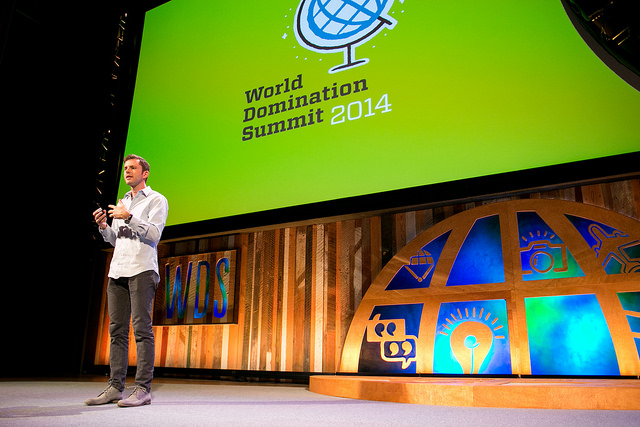
A few years ago the Baker Books acquisitions assistant at the time recommended Chris Guillebeau’s The Art of Non-Conformity to me. I loved the book. In it Chris points out that we don’t have to do life as it is almost always prescribed to us. We don’t have to earn a degree, get a job, and climb the ladder. Other, often more interesting ways to do life are available to us. If that sounds at all interesting to you, I encourage you to check out the book. It was certainly a game changer for me. In fact, this blog may not exist were it not for The Art of Non-Conformity. Since reading it I’ve been following Guillebeau, which led to my interest in the World Domination Summit. Cheekily named, Guillebeau’s summit is for entrepreneurs and creatives who want to get together, be inspired, and have a blast. It was one of the best conferences I’ve attended largely because of the people who came. I have a sneaking suspicion a big part of the magic of WDS is its nonprofit status. Chris does not pay himself for the event, the speakers present for free, it’s largely organized by volunteers, and proceeds go to benefit charity and the attendees themselves. The keynote presentations were uneven, honestly, but the energy of the community, the people I met, this insatiable desire for dream-catching that was thick in the air—it all made for a beautiful experience. Plus I got to hang out with some good friends like Kary Oberbrunner, Rick McKinley, Andy Traub, Jeff Goins, and Sandra Bishop. I also made some new ones like David Bourne, Austin Church, Lisa Bryan, Jessica Denninger, and Joshua Becker. I wanted to share 3 lessons (3 superpowers!) that I’m taking with me from the World Domination Summit 2014. 1. Don’t be afraid to set aside something that isn’t working to try something new. It sounds counterintuitive, but sometimes the fastest way to succeed is to quit. Then quickly try something else. But don’t confuse failure with a small start, which leads to the next point. 2. Don’t be discouraged by the small start. Most big accomplishments start small. Sometimes we try something, and the initial result isn’t what we’d hoped for, and we get all mopey. We need to give ourselves permission to start small–to just try something and see how it goes and be grateful for any positive return. Getting discouraged by a small start is like taking the first step up a staircase and getting mad because you’re not already at the top! You’ll never get to the top without the steps beforehand. The really sad thing here is that we can end up disparaging the very step we absolutely HAD to take to get where we want to go. Now imagine we get so discouraged, we stop. That would be the real tragedy, and it happens all the time. We need to be careful and vigorous about celebrating the small steps. That way we’ll stay motivated to keep moving. 3. Remember to pursue your dreams in a healthy way that nurtures your most important relationships. Michael Hyatt shared vulnerably about his father who was a drunk when Michael was in early adolescence. Michael was and is a driven man. He could have just forged ahead, done his thing, and forgotten about his dad or just checked off the minimum duties as a son. This, in fact, is what he did for some time. But later in life Michael decided to pursue his dad, to learn what he could about him. He learned that his dad had suffered terrible trauma in the Korean War, and that this contributed to his alcoholism. Michael found a way of reconciling with his father (even if his father never knew of the need for reconciliation). Accomplishing our dreams won’t mean much if when we get there we look around and all our important relationships are in tatters. Book Proposal Academy Speaking of starting things and accomplishing our dreams, I want to let you know I’ve just opened Book Proposal Academy. If you have ever thought about writing a book, I encourage you to enroll in the academy. It will remain open for just a few more days so a defined community of people can work on their book projects together. I think it’s going to be great. If you want to know more, click here. Let’s zero in on the second point. What’s a “small start” you need to take up this week or next week?
The Best Books Ever Written on Creativity, Writing, Platform, and Pursuing Your Dreams
Good books and the authors who write them make for some of the most helpful companions on the creative journey. Below is a categorized list of what I consider the best books out there on creativity, writing, platform, and pursuing your dreams. I commented on books I’ve read and loved. Others made the list either because I’ve heard so much about them they just have to be on the list, or because people I trust (including readers of this blog!) have recommended them. (This post includes affiliate links.)
How to Blog Your Way to a Bestselling Book [Podcast]
If you’re a blogger and haven’t discovered the Blogging Your Passion podcast by Jonathan Milligan, you’re in for a treat. Jonathan, a pro blogger himself, has a deep passion for helping bloggers take their blogs to the next level. He’s “been there, done that,” and he’ll show you how he did. Jonathan has become a good friend, even a mentor to me, so I’m delighted to let you know about him and his work. Interview about Blogging and Publishing I was honored for Jonathan to interview me about publishing and blogging a book on his podcast recently. If you’ve ever wondered about how to get your book published or how you could turn your blog into a book, I encourage you to listen to our podcast conversation.
The Quick Start Guide to Writing Your First Blog Post: 6 Steps
If you recently started a blog, this post is for you. If you are thinking about starting a blog, this post is for you. If you know someone who SHOULD be blogging, this post is for you. I’m talking about a guest post I wrote for my dear friend Jonathan Milligan over at BloggingYourPassion.com Here’s how it starts… This post will you give you everything you need for getting started on the right foot. Obviously there are no rules here, but a great place to begin is to let readers know who you are and what to expect. It’s important to do so in a way that is both honest and not too limiting. How do you do that? Keep reading!
Interview with Literary Agent, Author, and Blogger Rachelle Gardner, a Living Legend

I’m so pleased to bring you this Living Legends interview with Rachelle Gardner, a literary agent with Books & Such. Rachelle started blogging back before it was cool (I started after that) and has served thousands and thousands of writers over the years. She also has written her first ebook, with more to come. I encourage you to check out her blog at www.RachelleGardner.com. OK, let’s dive into the interview. I think you’ll enjoy hearing from Rachelle. Rachelle, lay it on us: What sort of author do you love to work with, and what sort would you prefer not to work with? This is a difficult question to answer because I work with many different kinds of authors, each uniquely individual, and I’m sincerely excited and grateful to be working with each and every one.